Penalties and Perks of an Ecological Education in “Woodlands of the Mind” https://ift.tt/LYPn9hV
When I studied landscape ecology, my favorite place to learn was the Duke Forest. At over 7,000 acres, the forest consists of former agricultural fields in various stages of “succession,” a term for how, over time, vegetation tends to move from grasses, to shrubs, to fast growing pioneer tree species, and eventually to mature forests. No single element of my education was as important or enjoyable as the time spent in that forest, witnessing time unfold over space.
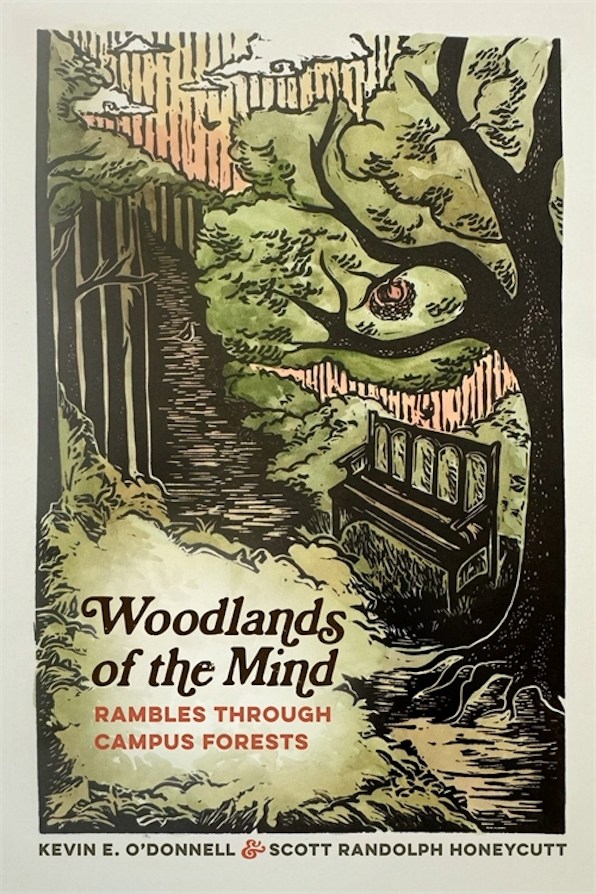
Kevin O’Donnell and Scott Randolph Honeycutt’s Woodlands of the Mind caught my attention because of this personal connection to university forests, and because no one, to my knowledge, has dedicated a book specifically to the woodlands of higher education. The volume gathers together essays individually written by each author that explore fifteen different college campus forests spanning four regions of the eastern US (the southeast, the Ohio Valley, the mid-Atlantic, and the northeast). In their “armchair travel book”, O’Donnell and Honeycutt aim to provide a brief window into these various campuses.
I can’t say that I am particularly familiar with the genre of travel literature. When I think of travel narratives, I think most readily of shows like Anthony Bourdain’s Parts Unknown, which takes you to a new place and tours you around, mixing in historical facts and local interviews. Even this version of travel storytelling seems to have been replaced largely by travel Instagram accounts, which remove much of the historical context in favor of images and short videos.
As a traditional travel book, Woodlands of the Mind is both refreshing and successful. The writing is clear, informative, and casual, as if learning from a guide on a hike. There are many detailed descriptions of beautiful hardwood forests filled with oaks and hickories, and pine forests ranging from long leaf to eastern white. O’Donnell and Honeycutt introduce us to a host of people involved in these forests, including the historical figures who originally protected them, the professors who teach in them, their students who learn in them, and the land managers who tend to them. The authors find countless opportunities to weave in critical issues in environmental circles from the last century, especially the degree of necessary human involvement in ecosystem management. These chapters cover a range of human stories intertwined with the forests, like the grassroots effort at Virginia Tech to protect their “Stadium Woods,” which were slated to become an expanded training facility for the football team.
Like national parks, university forests often protect wooded areas for biodiversity and public enjoyment. But university forests have the added mission of research and education. At the Harvard Forest, for example, there are countless research projects happening alongside one another; at Dickinson College’s Reineman Sanctuary, students learn how to lay out a transect in order to track ecosystem changes. I suspect that there might be some deeper way in which forests are well suited to thinking and intellectual development in general, as the authors hint at when they mention the ancient attachment between education and forests, but that speculative path isn’t explored further here.
More so than the philosophical link between higher education and woods, old growth forests are the collection’s inspiration. As the authors acknowledge, it is difficult to define old growth, but the term typically refers to forests that have not been disturbed or influenced by humans for hundreds of years. These forests have the full range of their ecosystem intact: large trees, many hundreds of years old, but also young and midstory trees, as well as dead trunks on the forest floor. Few old growth areas remain in the US; most of our eastern forests were logged for one purpose or another, with only about 1% of unlogged forests remaining. Many of the woodlands cataloged in the book are rare remnants of pre-European ecosystems. O’Donnell and Honeycutt describe these places with evident admiration; they have what Honeycutt calls a “reverence for ancient trees”. Having been to several old-growth sites myself, I can understand why.
While the authors certainly depict many positive experiences in nature — I think of a moving passage when Honeycutt sees a scarlet tanager in the Harvard Forest — much of the book is a catalogue of environmental destruction, exploitation, and degradation in the East Coast, including the pervasive history of logging and mining. O’Donnell and Honeycutt show how every protected old-growth forest is an exception, a product of a single person or group’s decision that a forest was worth protecting from a clear cut. Dickinson College’s Reineman Sanctuary, for example, was conserved because one individual felt that the forest, and especially its animals, were worth preserving forever.
O’Donnell and Honeycutt also highlight the challenges of protecting forests even after they have been acquired by well-intentioned universities. As these spaces are rarely protected with powerful conservation tools like easements, many could be sold off for development, as the authors detail in the chapter on Drew University. Even when universities secure these natural areas, they can still degrade from climate change, lack of prescribed burning, invasive species, pests like emerald ash borer, the woody adelgid, and chestnut blight, and the ever-present threat and challenge of a burgeoning deer population.
Taken together, the essays of Woodlands of the Mind leave you with an immense sense of loss and concern for the future, but with an equally capacious appreciation for the few but magisterial forests that remain. Aldo Leopold’s often referenced quote — “one of the penalties of an ecological education is that one lives alone in a world of wounds” — makes an apt appearance in this volume and summarizes its effect on the reader well. But there are perks to the ecological education provided by this book, too, like a new reverence for old trees, and a desire to head out into any one of these university woods.






0 Commentaires