The Overlooked World of Southern Gas Station Food https://ift.tt/HW6pw3F
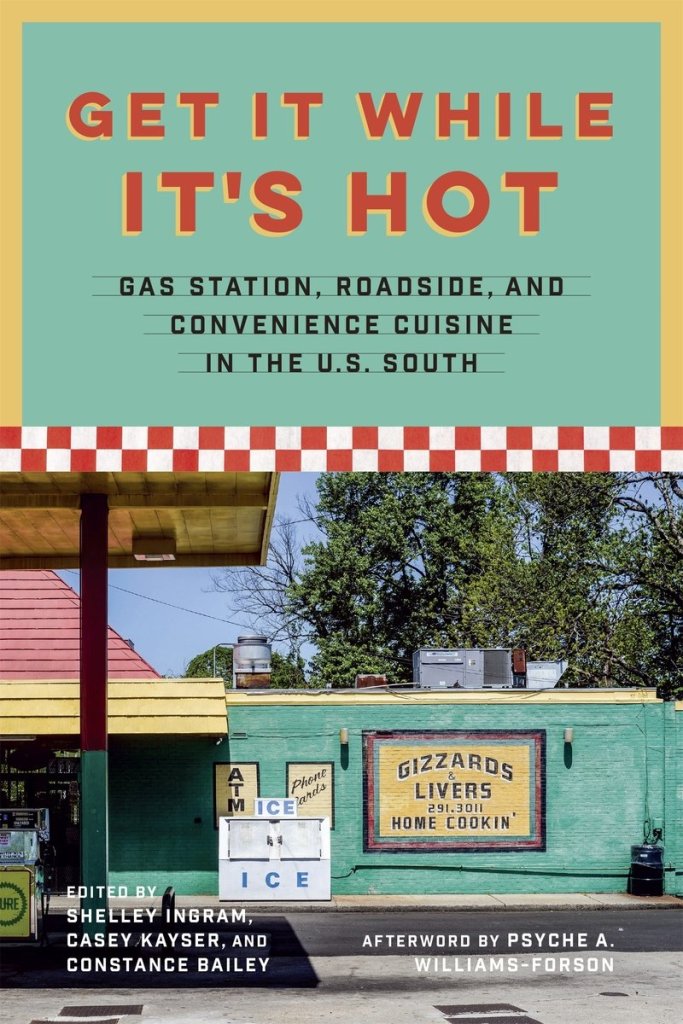
The food writing anthology Get It While It’s Hot, edited by professors Shelley Ingram of the University of Louisiana, Casey Kayser of the University of Arkansas, and Constance Bailey of Georgia State University, is, first and foremost, a textbook for any type of sociology scholar. It’s perfect for teachers who want to encourage students to think deeply about the economics of rural communities, social norms in third spaces, and the evolution of American culinary traditions.
Creative writing and journalism teachers may also use this textbook to inspire students interested in travel writing and food writing. The book covers such an eclectic mix of characters and settings that there are endless ways to mimic these observations and insights in regions beyond the South. Readers will meet Ms. Mable, the self-taught “candylady” of Natchez, Mississippi, the boisterous Tapp family of North Carolina’s Chicken Hut, plus the Texan bakery founders J.B. and Rosalee Hargrove, who expanded their business all the way to Louisiana and famously made Elvis Presley’s favorite roadside donuts.
The collection of essays, both personal and academic, explores the rainbow of ways, as University of Maryland professor Psyche Williams-Forson put it, gas station eateries in different Southern locations serve as “critical daily infrastructure” for millions of Americans.
When 15 seasoned professors, journalists, and researchers collaborated on this book, they applied their thorough and rigorous attention to a subject of food studies often overlooked or trivialized due to its association with working-class clientele. As this anthology reveals, gas stations and roadside convenience stores are actually rich cultural emblems offering unique insights into both local history and broader demographic changes.
The collection maps the evolution of both small, family-owned businesses and powerful corporate brands, like Southland Ice Company, established in Texas in 1927, which most readers will know today as 7-Eleven. These surveys of American roadside foodways highlight the ongoing tension between national homogeneity and unique, hyperlocal enterprises. Historically, these eateries were often the focal point of segregation or desegregation processes. In some Southern communities, the roadside eatery predates the addition of gas stations, and it may still be the only affordable restaurant in the area for many miles.
“While we abhor the systems of interlocking oppression that created the need for establishments like Eaton’s gas stations in Alabama, one of the only Black-owned gas stations nationwide, we understand their centrality and significance in studying Southern food,” the collection’s editors wrote in the introduction. “Food in the South is intimately linked to racial, ethnic, and gendered hegemony and socioeconomic inequities.”
This is especially true since roughly half of all food service employees across the country are racial minorities, despite the fact that “white-owned restaurants and chefs tend to claim the spotlight” in the national imagination of “Southern hospitality,” according to journalist Bailey Benson. These roadside eateries, where traveling urban families and agrarian communities engage in cross-cultural exchange, offer a different context for hospitality rituals. Multiple scholars noted the prevalence of Black women as entrepreneurs and proprietors in these establishments in times and places where that may have otherwise been uncommon.
Although food is the subject of the anthology, much more so than transportation, the authors note that these eateries don’t function like typical restaurants. Their strategic locations, in places of transition and boundaries between communities, set them apart from other food businesses. Fried catfish or spicy boudin may be served as well as tandoori-baked flatbreads, for example, due to the growing number of Punjabi truck drivers on U.S. highways and the fact that more than half of all American gas stations are owned by immigrants.
Regional offerings like livermush from the Appalachian mountains, a “loaf” of pork liver, cornmeal, sage and other spices fried in bacon grease, variations on prime rib and fried peach pies, or Creole corn maque choux with a splash of cream, all show gas stations in rural communities have menus beyond the stereotypical prepackaged chips and hot dogs.
“Gas stations in the South, especially, cook all their fried chicken and everything usually early in their morning because we’re still an agrarian society,” Ingram and Bailey wrote together in their essay “The Tailgate Review,” adding that farmers pick up lunch along with coffee early in the morning and may keep it in a cooler during the workday.
Plus, as bakery operator Emily Whittington noted in her essay, “Gas Stations, Food and Community,” roadside eateries may operate in regions without larger grocery stores. “It is not uncommon for convenience stores, either located at a gas station or dollar store, to be the community grocery store,” Whittington wrote.
Some of these gas stations sell beauty supplies or fishing equipment as well. There are more than 120,000 gas stations across America that sell some type of food, in addition to the wide variety of full-scale restaurants close to fueling hubs.
Overall, this collection encapsulates the complexity of human connection in third spaces given emotional significance through both nostalgia and the sense of discovery wrapped up in the rich history of Southern foodways.
“Perhaps the most alluring aspect of convenience stores, at least when on a roadtrip, is the sense of possibility,” wrote Nebraska-based professor Mystery Harwood. “Gas station culture wasn’t the same everywhere.”
NONFICTION Get It While It’s Hot By Shelley Ingram, Casey Kayser, Constance Bailey Louisiana State University Press Published April 24, 2026






0 Commentaires