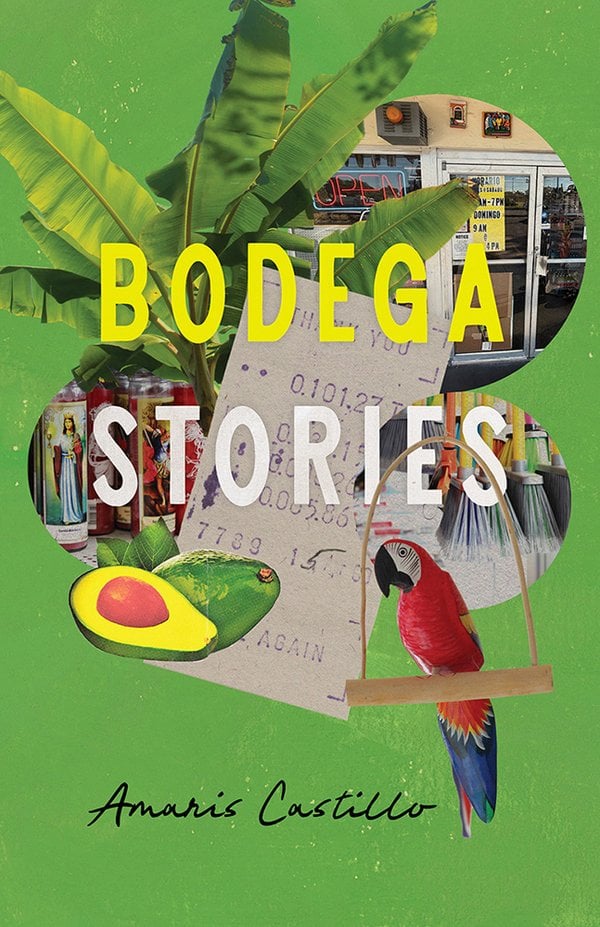
“Bodega Stories” Celebrates Community as much as Family https://ift.tt/rHPL0Fw
A book about a place is more than about the place itself; it is about the people who inhabit it, the norms and culture they create within it, the times in which they live. Amaris Castillo’s Bodega Stories, a collection of sixty-six vignettes about the Dominican bodega the author’s hardworking parents ran in St. Petersburg, Florida, depicts the many sacrifices her family made to survive and, in doing so, demonstrates how they built a community that enabled them to thrive.
More than a marketplace, Freddy and Damaris Castillo’s Orlando Latin Market becomes a center of Latino social life, a cultural exchange. Castillo’s collection tells the bodega’s story with its people. The lives of the family, friends, and customers are inextricably linked to the foods they buy, the meals they prepare, and their origin stories. Most of the customers are immigrants and their descendants — many Cuban, but some from El Salvador, Peru, Colombia, Mexico, Ecuador, and Honduras, drawn to the bodega’s rich inventory of foods and products from their former homes, seeking hard-to-find ingredients and familiar dishes prepared in-house: “traces of the countries they left behind.” One customer, a poet and author named Gloria, delights in a shelf dubbed “Little Colombia.” Aisle 2 of the store is where customers find every imaginable brand of bagged dry beans: “lentils, guandules/gandules/pigeon peas, white and gold hominy.” There are rows of olives: “salad olives, Manzanilla olives, olives for your cocktail.” Every inch of space is a homecoming for someone.
The author’s gratitude and respect for her parents are deeply felt throughout the narrative. Her father, Freddy, is a lifelong bodeguero – perhaps, to some, a storekeeper, but as portrayed by Castillo, a dedicated professional, a broker of cultural diversity, and a caretaker of the neighborhood. Her uncle and grandmother were also bodegueros, performing the same “admirable work.” Castillo situates the bodega in its social and cultural past: part family-owned business, part community anchor, part historical institution.
The customers are as human and colorful as they are industrious. A young Cubano named Miguel wanders into the store to replace a broken mop and tells of his dream to become a trucker after his acting career faltered (“no dinero”) while he fills his cart, shopping with a cousin over FaceTime. Chico, the neighborhood barber and a frequent customer, is an imposing figure with tattoos, diamond studs, a closely-shaven head, and gold in his teeth that glints as he smile; he mandates kindness and hugs from his employees and customers. A group of Pentecostal women wearing black T-shirts with “Jesucristo es la Respuesta” (“Jesus is the Answer”), comes by each Sunday “with kind faces and leaflets in their hands”; they remind customers that they are loved and do not threaten nonbelievers with hell. “God isn’t like that,” says Giseliz, one of the women.
The store’s employees are loyal and hardworking, putting up with less-than-ideal conditions and cramped space. Self-taught cook Alberto (who claims all Cubans know how to cook) arrives every morning shortly after five to prepare vast quantities of rice, beans, and pork rinds in a tiny kitchen with creamsicle-colored walls coated in grease. Liset, juggling jobs both at the bodega and the local McDonald’s, is a “one-woman assembly line,” working tirelessly to keep up with customer demands for Cuban sandwiches. Tia Margarita, Castillo’s mother’s glamorous older sister, explains how the pace of work has become more demanding, competing with the bodega’s lively social life. She used to talk more than she worked, and “now we work more than we talk.” The work is mentally and physically draining. Get this for me! Where is this? Are you going to order that? Yet she and the others take the conditions in stride, confident that something better will follow. On the day of her retirement, Tia Margarita locks the bodega’s front door one last time, saying, “Life is about cycles that you close.”
Castillo does not over-glamorize bodega life. Into the bodega “walk deeply flawed humans,” she writes. She feels intimidated by the “creepy male gaze” she experiences working as a cashier, the barrage of questions and complaints, the pressure she feels as the eldest child of immigrants to be the “cultural broker.” The bodega is tiny, about the length of a gas station. The oficina is a crowded storage room stacked with Styrofoam containers and boxes of fruit juices, cases of Coca-Cola bottles wrapped in thick plastic serving as its seating. The oppressively hot basement, where returned bottles must be sorted and stored, is “a rehearsal for hell” that no bodeguero wants to be sent to. There is always the threat of a robbery or an unexpected visit from the health inspector. Yet her family makes the best of it, enlivening the store with boleros played through a Bluetooth speaker connected to her mother’s phone. Voices in Spanish become the bodega’s soundtrack, requiring careful navigation of words that have different meanings depending on where the speaker comes from.
Intimacy and a sense of community permeate the place. In one memorable scene, her father reproposes to her mother, Damaris, in a burst of spontaneous affection: “Freddy kneels down in front of her. He smiles. His eyes glint with playfulness. He’s holding something circular and blue. A ring. Damaris smiles, too, as he reaches for her right hand,” and her smile stretches wider when she discovers the ring is “what’s usually left on a bottle after you unscrew the cap.” Liset offers a message of hope for other immigrants. “Little by little, things will start to flow. Things will fall into place [. . .] life will start to reward you.” On the eve of a tropical storm, there is a frenetic symphony of crinkling plastic bags, an endless airing of everyone’s preparation plans, the low murmur of customers talking to themselves while “No Hay Cama Pa’Tanta Gente” (“There’s no bed for so many people”) plays softly in the background.
The book’s structure is ideal for an intimate account of a family and a community. Short vignettes capture brief interactions, letting the reader fill in the gaps and absorb the commonality of everyday immigrant experience. Castillo’s interviews become intimate conversations. She cleverly integrates artifacts – the store’s bulletin board with its ample posts of “efficiencies” for rent, a Facebook page with a continuous list of “Does the store carry . . .?” questions (Jamaican products? Authentic Puerto Rican pasteles? Peruvian corn, canned or frozen?), family photos – to color the stories, creating something as much an exhibit as a narrative. She fills in the individual accounts with moments from social history – the Dominican migration, the Cuban revolution, the proliferation of Puerto Rican bodegas in New York, the relocation to Florida – giving her family’s and community’s history relevance and context.
Bodega Stories is a fresh account of hardworking people, burdened by disconnection and its financial challenges, yet finding joy in life and common ground in immigrant experience. Castillo, a journalist by profession, succeeds in rendering a balanced story, conveying realism without losing the warmth of her connection to it. The experiences the book depict are not just discrete events but part of an ongoing saga. Life, indeed, is about the cycles we close, but also about the possibilities that are kept open.
NONFICTION Bodega Stories By Amaris Castillo University Press of Florida Published September 8, 2026






0 Commentaires