“Talking with Boys”: Finding Freedom in Forward Motion https://ift.tt/CR4BTHI
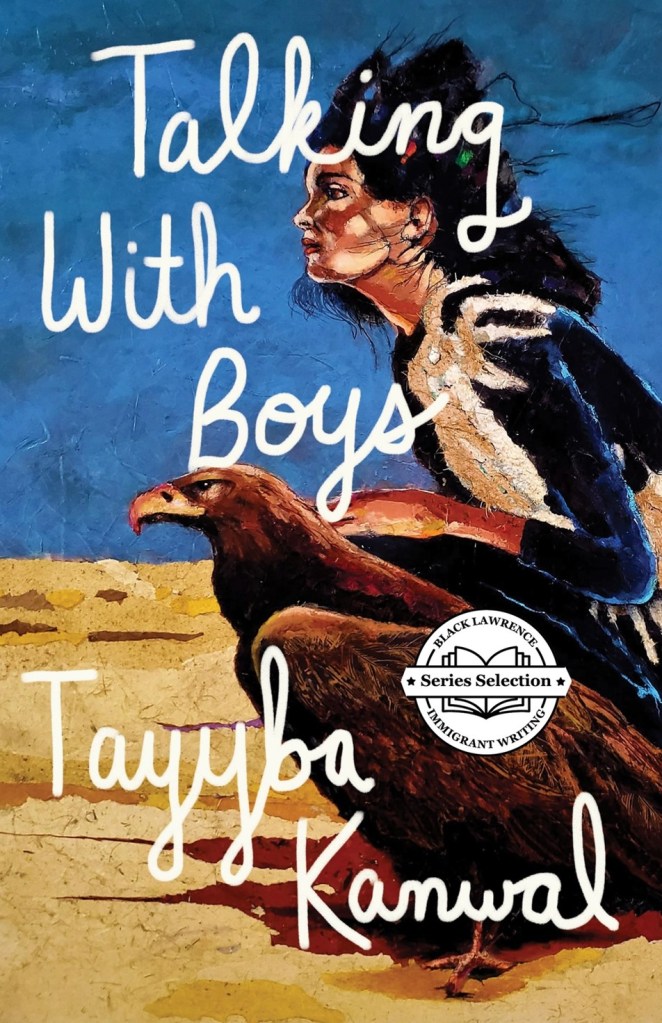
For fans of diaspora and feminist literature, Tayyba Kanwal’s debut short story collection Talking with Boys is a must read. Kanwal’s prose combines Sandra Cisnero’s lyricality with Jhumpa Lahiri’s profound cultural understanding, but with a voice that is uniquely her own. Each story captures the Pakistani and Pakistani American experience in a way that will linger with the reader long after. To read Kanwal’s work is to gain empathy, to connect with stories different from your own.
In Talking with Boys, Kanwal’s characters are in constant flux. They move across continents and cities and even within the confines of their own homes. Motion becomes an act of survival and self-definition for those whose lives are circumscribed by expectation. Spanning Houston, Lahore, and Dubai, the collection testifies to the power of women and girls who refuse to remain still.
Kanwal establishes the theme of motion from the very start. In her opening story, “The Girl Who Ran,” Amal, a young woman who feels constricted by the expectations of her family, flees her home to marry. However, in doing so, she finds that tradition follows her in different ways. She begins to long for her roots, seeking connection through her mother-in-law, Zeba. Kanwal uses Amal’s experiences to paint a picture of youth: the lostness and the longing that define adolescence. For Amal, motion is at once an escape and a return to her cultural identity.
“Mehr” is another story about runaways. In this surrealist take on the burqa, Kanwal paints a portrait of a girl’s life in Pakistan in 1986. Mehr lives with her father and often thinks of her mother, who fled their home when Mehr was very young. The story traces Mehr’s ascent to womanhood beside the cultural tradition of wearing a burqa when one comes of age. At first, Mehr is hesitant to don her burqa, believing it will erase her identity, but then discovers that it gives her wings:
“She felt a strange terror and sense of freedom she never imagined could coexist in her; it was as if she stood in the middle of that marshland behind their house and could see in all directions, yet was afraid of what might be behind her.” The burqa, once a symbol of constraint, becomes Mehr’s liberation. Like her mother before her, Mehr uses her wings to break free from her father and the patriarchal rule he embodies. She flies away, finding selfhood through motion.
The title story, “Talking with Boys,” similarly explores what it means to chase independence within social confines. Like Amal and Mehr, sisters Mariam and Sana seek to define themselves outside their parents’ rule. Forbidden from talking to boys, each sister rebels in a different way: Mariam ends up in a traditional marriage with a young Pakistani man while Sana becomes engaged to Dylan against her parents’ wishes. When asked why she chose this path, Sana’s reply in sign language is illuminating: “He speaks my tongue,” she says. Her answer serves as a moment of freedom, reminding us of the ways language, love, and identity intersect.
Perhaps the most powerful story of the collection takes the form of “Huma and the Birds.” Set in 1980s Dubai, the story follows Huma, who leaves her family in Pakistan to serve as a maid in a wealthy household. At first, Huma feels settled in her routine, cooking, cleaning, and doing laundry for Mr. Suleiman and Madam. Yet the longer she works there, the greater the power imbalances between the masters and servants become. In a heartrending exploration of power dynamics within oppressive systems, Kanwal returns to her main motif: motion as freedom. When read alongside Amal’s impulsive escape in “The Girl Who Ran,” Huma’s calculated attempt to free herself and her fellow servants highlights the spectrum of choices women make when faced with domination: sometimes running, sometimes staying, sometimes stealing back the means to move.
Across these stories, Kanwal’s characters question the authority of men and the traditions imposed upon them. They run from fathers, husbands, and masters; they grow wings, steal passports, and speak forbidden tongues. Each act of movement is a gesture toward liberation even when the outcome is uncertain. In the end, Kanwal leaves us with a striking truth: freedom lies in the courage to keep moving forward.
FICTION Talking with Boys
By Tayyba Kanwal
Black Lawrence Press
Published January 6, 2025







0 Commentaires