Writing “the Necessary Poems”: An Interview with Lolita Stewart-White https://ift.tt/GROlxXu
Lolita Stewart-White is a poet, playwright, and filmmaker from Liberty City, Florida. She is a Pushcart nominee and winner of the Paris American Series Prize. Her poetry has been featured in Ploughshares, Prairie Schooner, Beloit Poetry Journal, the Boston Review, and the African American Review. Stewart-White is an alumnus of Miami City Theatre’s Homegrown Program and a Dramatist Guild Foundation National Playwriting fellow. She is a Cave Canem Fellows Fund Project Grantee for her play-in-verse, Liberty City Vignettes, currently in development.
Most recently, Stewart-White is the author of black frag/ments, her debut poetry collection, selected by Ashley M. Jones for Hub City Press’ 2024 Deep Line Poetry Series. I had the honor of editing the two books selected for the series at the time, and I first met Lolita over Zoom in October of 2024 to learn her manuscript’s moving origin story and discuss her plans for the book. Written in the aftermath of her husband’s cancer diagnosis, black frag/ments explores the fragmentation of Black bodies, families, and communities facilitated by the historic and ongoing racism in the US healthcare system. Most importantly, it is an archive of the ways love endures.
Over a year after our editorial back-and-forth, I caught up with Lolita on Zoom about her journey to publication, the many facets of medical racism, and Black love.
So, I’d be curious to just go back to the beginning. Let’s talk about the formation of the book. When did you know that it was going to be a book of poetry, especially coming from someone who writes all sorts of different mediums?
It was happening in real time when my husband was hospitalized with esophageal cancer. My mentor Toi Derricotte from Cave Canem teaches a workshop about writing hard poems. I thought I had written difficult poems in the past. I had no idea how I’d be tested when facing the notion of death. I found myself grabbing napkins, spit bags, and medical papers to scribble down the tsunami of trauma that was coming to me. I thought a lot about Toi during this time.
While you were writing these things down in real time, were you thinking about how other people would perceive it or about explaining it to other people? Or did it feel, in that moment, purely just for your documentation?
In the beginning it was a way to document my feelings. I wasn’t thinking about a book. My writing was a way to survive the ongoing trauma that the family was experiencing. The poems in black frag/ments are potent because they reflect what was happening in the moment. There are pieces in the book written after my husband was in remission, but the majority came to me in chemo suites, radiation labs, and doctors’ offices.
Okay, so when did it flip for you that this might be a book?
It happened months after my husband completed his treatment. I was taking a class at the Fine Arts Work Center called ‘The Poetic Sequence.’ It was taught by the poet Rebecca Seiferle. She describes a sequence as “a long poem that combines shorter pieces by relying on association, juxtaposition, and connection rather than theme or narrative to create an organic whole.” The process of working with Rebecca led to creative breakthroughs that I hadn’t experienced before. I was able to take many of the notes I had written while my husband was hospitalized and incorporate them into a poetic sequence. This would be the beginning of black frag/ments. Rebecca felt this could possibly be a book and encouraged me to continue to write.
Wow. So then in the book, I’m thinking about how you incorporate the voice of your husband, even the voice of your daughter. There are letters and documents from both of them. Did you consult with them at the time?
The letters included in the book were written by my husband and daughter. They each chose the ones they wanted published. I don’t think those particular pieces would have felt as authentic had I written them myself. There’s also the poem “Q & A” where my daughter is in a counseling session, and that too is in her own words. As far as the other poems are concerned, I’d read them aloud and get their thoughts on how they felt about what was being said before putting them in the book. It was hard, because in ways it was reigniting the feelings, but it was also healing. As a family, we realize black frag/ments is important because it sheds light on the brutality that Black people experience. The fact is that the bias in health care, education, and the criminal justice systems is dangerous and can cause black people’s premature deaths. I was reading an article about the Cincinnati radiation experiments that happened in the 1960s and 1970s. African-American cancer patients were given high doses of total body radiation to simulate the effects on what soldiers on the battlefield would experience. Then we wonder why Black people are fearful of going to the hospital and are ultimately diagnosed late.
Absolutely, and I feel like you do a really cool and interesting job of bringing in that living history throughout the book, bringing it back to Henrietta Lacks and even linking it to police brutality and all the ways all of this is connected. Did you have any sort of research process for all the things that you wanted to include? Or were these just real-time connections you were making?
There were things that I, of course, knew about. I read the book Medical Apartheid by Harriet A. Washington. There’s also Bettina Judd’s Patient and Kwoya Fagin Maple’s Mend. These books do a great job documenting the blatant experimentation on black bodies. This has reverberated throughout the history of Black families and is what I grappled with when my husband was under the care of white doctors. What I feared the most was the dismantling of our Black family. In my mind, the Black family has always been and continues to be under attack. This book is about cancer, but it’s also a love letter to the Black family.
It really is, and it really comes through so beautifully. I’m thinking about you weaving in intergenerational conversation with the voices of the ancestors down to your daughter. And I even made a little note, because I really love the poems where you have the epigraph that just says, “circa back in the day” that show these beautiful moments of you and your husband. That love is so tangible.
I don’t think white people want to believe Black people can love each other that fiercely, because to believe that is to believe we’re human. Black frag/ments is a love poem and concludes with the Sounder poem that you and I talked about a year ago.
[Laughter] We did talk about this. The last poem in the book.
I know you’ve never seen the movie Sounder because you’re too young. There’s nothing more beautiful than the ending scene when Nathan (Paul Winfield) comes home to Rebecca (Cicely Tyson). I can remember seeing when the father reunites with the family. I was in the theater with my parents and was awestruck. That’s why I wanted to end on that poem — to show how strong the reuniting of the Black family can be.
And I’m so glad that is the present thread through the book. I feel like that is so important to share. That poem is the best ending, actually weaving in all the themes in this love story to a close.
I hope that love in the book resonates with people despite the subject matter. There is the love of family, but also love of the ancestors who were present in the spaces advising and protecting us. This chorus of elders reemerges in black frag/ments again and again.
Is there any particular way for you that you commune or communicate with your ancestors or feel them?
For me, I’m talking to the ancestors constantly. I do on an everyday basis. Some people call it God, some people call it the universe. I call it the ancestors. I believe that they’re with us all the time. So when I’m writing, I’m communicating with June Jordan, Lucille Clifton, and Pat Parker. I feel like my writing is bigger than myself because I am contributing to the Black canon of work. I’m thinking about my mentors Terrance Hayes, Patricia Smith, and Cornelius Eady. These are the poets [who] want to see the next generation of Black writers bloom. black frag/ments contribute to the ongoing narrative. It’s important as Black writers that we document Black life because it’s constantly being erased. My work is connected to the elders before me and presently doing that work.
Wow, thank you for this.
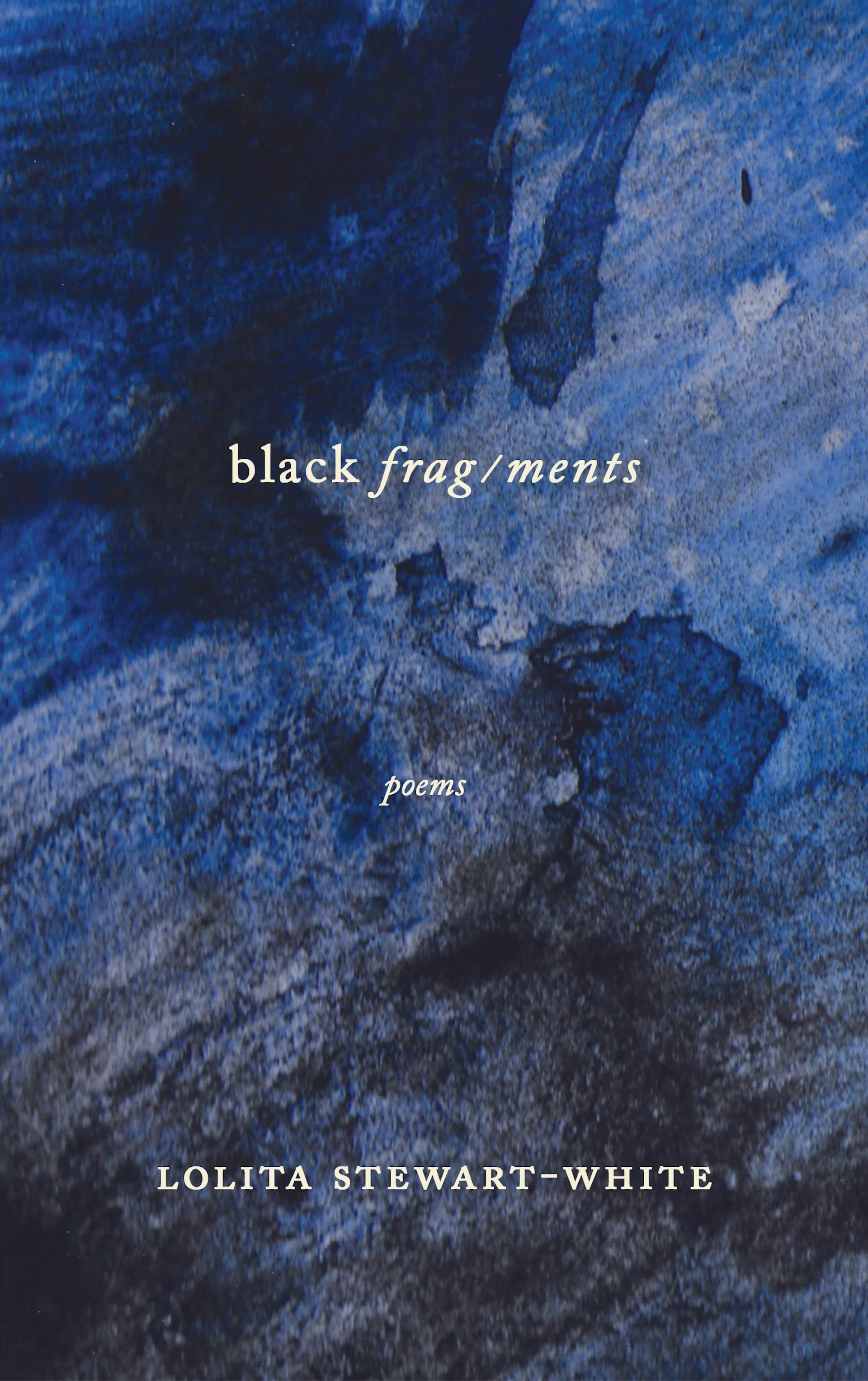
I also wanted to mention Chris Watts, the artist who designed the book cover. He’s an incredible visual artist and AMAZING human being. I met Chris in 2014 at the Atlantic Center for the Arts. We were there as fellows and immediately developed a creative kinship. He promised that whenever I was ready to publish a book, he’d design the cover. Chris Watts kept his promise! Such a talented brother.
POETRY black frag/ments
By Lolita Stewart-White
Hub City Press
Published February 3, 2026




0 Commentaires