A Conversation on Grief, Sonnets and Ekphrasis with D.S. Waldman https://ift.tt/AvPDQ3o
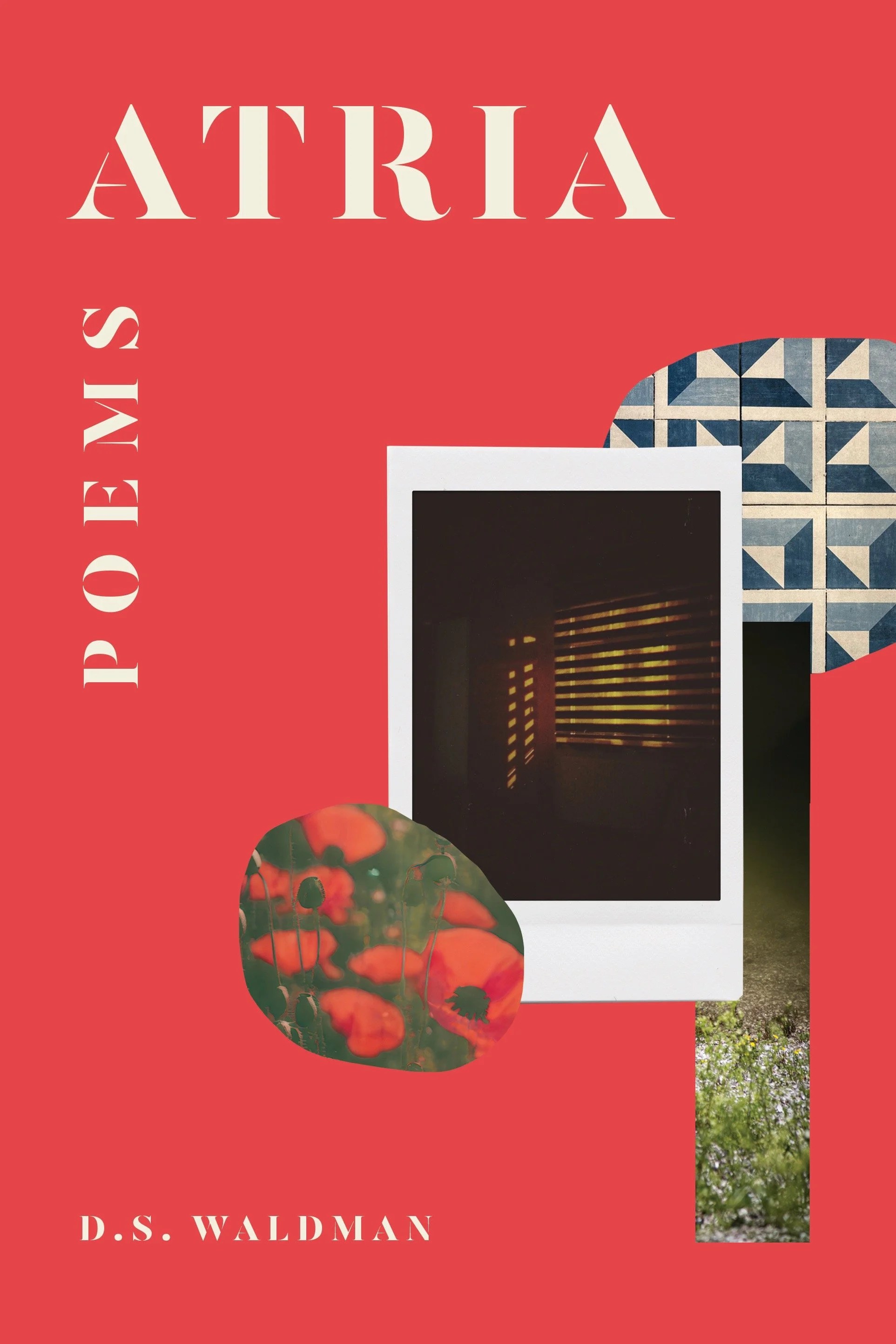
D.S. Waldman is the author of the poetry collection Atria. His writing has appeared in The New Yorker, The Atlantic, Los Angeles Review of Books, ZYZZYVA, and many other publications. A former Wallace Stegner Fellow at Stanford University and recipient of Poetry Society of America’s Lucille Medwick Memorial Award, Waldman lives and teaches creative writing in New York City.
When I came into contact with your work you were already writing about the subjects that inform Atria: how art, therapy, the body, relationships, and family each exerts influence over language and affect. What draws you to these subjects? Are you still drawn to these ideas after writing the book or has writing the book closed you off from them?
I think we all, as writers, have our obsessions. These subjects you list — and I would add to it geographic tension, specifically the between the rurality of my youth and the urbanity of my present life — all have informed my biography, who I’ve come to know myself to be. First books of poems often feel like bildungsroman, these semi-narrative collections of poems that amount to a coming-of-age story. I felt a little averse to that structure, maybe because I came later to poems — I didn’t write my first poem until I was 27, so childhood felt already kind of far away and a little less interesting to me. So maybe I was interested, even if subconsciously, in a book that said “this is who I am,” but did so by directing the reader to the subjects, events, relationships, that I felt most influenced who I was when writing it (ages 31-33), as opposed to the familiar coming-of-age situation.
And I definitely feel like some of these topics are closed to me, but not all of them. I’m still, for example, writing into my intertwined experiences of art/art making and disability, but I’m interested in doing that now through a more discursive, non-fiction mode that involves researching other artists from the canon who practiced with manual disabilities. And the novel I just finished revising has a lot to do with relationships and therapy, but is more specifically interested in the fragile male psyche and whiteness. So maybe it’s less that these topics are closed to me than that they have necessarily evolved and gone in new directions.
But thinking about overlaps in our work and interests, something we share is that we were both brought up in flyover country, in the rural American South, you in Arkansas, and me in Kentucky. I’m interested in how you might situate that upbringing within your poetics, and specifically how you thought about rendering that place in this collection, and also how, generally, you feel like that upbringing has influenced you as a person and poet.
Arkansas began entering the poems in a consistent way when I realized I had inadvertently adopted the imagery and atmosphere of work by Latinx writers from the southwestern US — Manuel Muñoz, Natalie Diaz, and others. When I was in graduate school at Indiana, I wrote a poem that thought about the history of immigration in my family and included elusive images of desert acacia and lizards. My friend, the poet Noah Davis, made some remark like, but didn’t you grow up in the Ozarks? While the poem was about a specific memory of mine and not just pastiche, I felt compelled to take seriously the task of describing where I grew up, and what being Mexican American in that space might have looked like. It became important while writing the book to note that the river in a poem is the White River of northwest Arkansas, and that the people in that river were of mixed origin themselves, to locate the language of the poem in that specific matrix. The book is about finding language to rename and remix the origins of the voice while other parts of the self work to undermine that effort.
Since voice has come up, I read in Atria, across all the myriad content and forms in the book, something distinctly elegiac in the voice and tone. In “For three years,” the speaker acknowledges the direct connection between their becoming a painter and their grief. Is there a link between figuration, interpretation, and grief that is fundamental to you?
Definitely. My brother died when I was 23, so there was a four-year lull between when he died and when I started trying to make poems. And in truth, I didn’t have a lot of language those years. It was a pretty quiet time. That’s probably part of what drew me to painting. To be clear, I was never very good; it truly was more of a therapeutic creative practice than anything, moving acrylic around a canvas, letting it dry, then covering the old paint with new paint (canvases are very expensive… I couldn’t afford too many of them). I painted with brushes, my hands, big cocktail ice cubes. Even thinking about it now, putting it to language, I’m reminded of how comforting it was to express — or in your words, figure, visually interpret — without having to use language. There’s that thing Louise (Glück) wrote in an essay about silence, that she wishes entire poems could be made out of silence. And I think the older I get, that resonates with me more and more. Some experiences are meant to be felt or endured or relished, and language cheapens them, or at the very least falls short in describing them. Losing my brother was like that.
This is a bit of a leap, but another interest or theme our books share is “the body,” the speaker including and addressing their own body, and their sometimes complicated relationship to their body. In Body Sweet, Betting the House, After, The Bull — all of these poems seem especially interested in this. Can you speak to the body as a recurring emphasis in the book?
In the book, the body is the site in which care, desire, and violence converge. It’s also a site of shame. For reasons that aren’t entirely clear to me, I feel it’s necessary to voice, work through shame out loud, on the page. It’s a potent subject — almost too large not to engage.
You write also a lot into your family of origin. The poems seem to navigate that at both the personal level — writing into your brother and mother and father, grandparents — and also the political, growing up in a Mexican American family in the South, with a father who immigrated from Mexico. I’m interested to know more about that process, writing the familial and political, the familial as political, the familial as familial, etc.
I wouldn’t be the first person to suggest that the family is an arena of politics rather than a sanctuary from it. For me, childhood featured relatives contending with documentation status that was up in the air and other forms of similar precarity. I grew up with my dad telling me stories of his migration and finding work while undocumented. When my dad was granted citizenship, I was in elementary school. In the eyes of the state, we became an American family, a part of the persuasive, fraught discourse that attends that designation. That contradictory script entered the family itself. The poems in the book that engage with family as family, as you put it, are shaded by those circumstances.
Another leap, though maybe related: just as the family is an arena for politics, I can’t help but think — going back to Atria — about art generally as an arena for politics. Why artworks by famous artists? Why begin in the museum?
It’s funny, museum poetry and ekphrasis are really having a moment. I don’t really know what that’s about. My educational background is an art, art history, architecture, so the museum has always been a pretty comfortable place to think. I also think there’s something effectively distracting, as writers, about looking at art — we’re always excavating the self, one way or another, and visual art and film and music are for me, and I’m sure for others, a way to look at oneself through the prism of this other made thing, a painting, a song, a performance. That said, I also think ekphrasis is hard to do well, or hard to do in a way that feels fresh; the tradition dates back at least to Homer. I’m not sure whether I pulled that off, but I tried.
In terms of the intersection of art theory and autobiography: In the notes, you acknowledge that one effect of positioning the essay “Low Poetics: A Meditation” next to your sonnet sequence “Low Theory” is that you get to redistribute the personal history and literary claims of the essay throughout the lyric disjunction of the sonnets. But what felt important to you about including the essay, which explains your case (or affinity) for poetry that resists singular interpretation and makes explicit your disability, alongside a sonnet sequence that resists explication? Which piece came first?
The sonnets came first, and you might remember I brought them into our Stegner workshop — my first. The general consensus was that the sequence needed context, which I resisted at first. I’d never written explicitly about my hand, the accident, the disability, and wasn’t sure I wanted to. But as an exercise I started the essay, and the process of writing it ended up being pretty important to me, personally and creatively. I realized I actually did want to be seen in that way, and did want an opportunity in the book to flesh out how that injury impacted the way I see, and how I move through the world, and how my study of art helped facilitate that more complete self-understanding.
Thinking about moving through the world, the title of your book comes to mind. Can you say a bit about the title? What it evokes for you, and what you hope it might evoke for your readers?
At the Park on the Edge of the Country serves double duty as the title of the collection and as the title for a truncated sonnet in the book. The park is specific in the context of that poem — a park in Ciudad Acuña — though the country refers to Mexico rather than the US. In the context of the book, the title navigates through a thicket of specificity. I hope the title indicates the transience of the voices and memories in the book: they are at and on and of. Its three prepositions might pull the reader between those spaces. In that sense, it’s three titles in one. Plus, it’s fun to have a title that has a high chance of being misremembered or misquoted.
“The Bull” is one of my favorite poems in the book, a poem I bring into the classroom whenever I teach persona poems. Could you talk a bit about the process of writing that poem? Were there any poems or poets you were looking at while working on it?
“The Bull” came about during my second workshop with Louise Glück at Stanford. I had been sharing work that relied on narrative, earnest speakers, and epiphany, which she distrusted, found boring. On a lark, I wondered if persona could be an effective way to expand my range, be entertaining.
I see now that the poem is influenced by, trying to integrate lessons from, Louise’s teaching and her poetry. The persona, the assured cadence, the invocation of the speaker’s death, the present absence of the father, surprise, humor. Writing it, I could see how talking about how I talk about my dad could be an effective subject in itself. “The Father” is another persona poem in the book that riffs on these ideas, reverses them. Along with Louise’s persona poems in The Wild Iris and Faithful and Virtuous Night, I can see the influence of Gerald Stern’s “The Dog” and Ross Gay’s “Ode to the Flute,” even if I wasn’t reading or thinking of them while composing the poem.
After it was written, I didn’t bring the poem to Louise in conference or to workshop for a few weeks. In part, I didn’t want to know yet if she (or the room) wouldn’t like it. This turns out to be a good test for me: if I want to circulate a poem immediately after writing it, it’s probably no good. If I want to safeguard it, the poem might be something. It’s among the few poems of mine that Louise ever voiced enjoying and she encouraged me to steer (no pun) into its mode.
Your own work, especially as collected in the book, cycles through forms: prose poems, lineated lyric poems, essay, sonnet sequence. You also cycle through at least as many genres: ekphrasis, literary criticism, art criticism, narrative poetry, the fragment, the disjunctive lyric. When writing these poems, did their forms emerge from a consistent procedure / compositional practice (i.e., did you have a sense that there needed to be a certain number of prose poems, a certain number of lyric poems) or is the variety an outcome of trial and error? Which form do you like best?
To some degree, I think I’m just formally restless. For example, the first poems I wrote for the book were the sonnets in the middle — over two or three months I worked on these things, writing probably twice as many as ended up in the book. And once I had the crown, you couldn’t have paid me to write another sonnet for this book, or another formal poem, and honestly it even took a while to write another lineated lyric poem. It felt like I needed to stretch out across prose sentences. Prose is also generally where I feel a little more comfortable. I have a baseline suspicion of verse. When I see linebreaks, I see a poem announcing itself as divine: here is my lyric utterance, which will transport you, briefly, to the heavens, glancing off the divine, the face of God. And there are plenty of poems that pull it off — Eavan Boland’s “Quarantine,” Oppen’s “Psalm,” Clifton’s “blessing the boats,” and you have so many beautiful lineated poems in your book — but I also think it is an easy habit (and for me, destructive, or at least self-defeating) to use linebreaks to elevate content that might not otherwise be very compelling. Or maybe it’s just that I, personally, don’t have all that much to say that would require a direct channel to the gods. I prefer common speech, a tone shared between friends on a park bench or catching up on the phone. I find there’s so much opportunity for Poetry in prose, and that definitely informed the shapes language takes in this book.
POETRY Atria
By D.S. Waldman
Liveright/WW Norton
Published February 17, 2026







0 Commentaires