“Of Water Never Ceasing” Expands Our Understanding of Pain https://ift.tt/pMziwXD
Of Water Never Ceasingis Kristin Entler’s debut collection of poetry, and not only is it stunning, but this collection also uplifts the kind of voice that many Southern poets hope to see receive attention. As we know, the long history of publishing in America and the South has privileged the voices of the heteronormative and able-bodied writers, so it’s important to see Loblolly Press promoting voices that may have been previously unpublished. Diagnosed with cystic fibrosis in infancy, Entler’s voice poems create a truer reflection of the South — one that captures the physical realities of living now, living here.
As a writer living with a chronic illness who loves water, I committed to reading this collection after its announcement on Instagram. I’ve been reading about pain for longer than I’ve had a diagnosis; Audre Lorde, Meghan O’Rouke, Lisa Olstein, and Johanna Hedva are among my favorites. Long have I been trying to figure out how to move language across a page in a way that describes ineffable pain and its complications — the way you are both stuck in your body and at its mercy, how inhospitable that can make everything. If Wittgenstein was worried about his inability to express love, our inability to express pain concerns me most. Entler’s poems further extend our discussions of pain in such a way that we can recognize our own pain in theirs and can expand that understanding to the multitudes who live pain-free.
In our daily dialogues, we revert to idioms to illustrate our pain, which shows just how elementary our means of expression are. For example, I’ve scanned medical articles and patient accounts of my own condition, looking for commonalities in language; it turns out we all report feeling like we “got hit by a bus.” In Entler’s poem, “When I Say My Pain is an Eight, I Mean,” Entler addresses this directly. By playing with both sentences, lines, and word forms, the rhythm is off kilter in the first stanza. There’s a frequent caesura, not in the middle of the line, but instead just before the last word. This imitates the speaker’s struggle with both pain and its expression. Indeed, the first stanza ends with “my tense and aching.” From this, “body” is omitted, and we feel the speaker is nothing more than their body, just its agonizing adjuncts. Even the gerund “aching” is the least active form of the verb. In the second stanza, there’s a clear loss of control — especially of the body. But there’s an acceptance in Entler’s poignant images that becomes this poem’s wisdom. Somehow, this poem helps us understand the pain, the acceptance, and that the self is not lost in it.
It seems to me that English is a language so connected to productivity that even its growth makes few attempts at better articulating the experience of anything unproductive, especially a word like “pain,” which carries with it the long history of systemic medical sexism and racism. Even the structures through which we discuss pain are maladaptive. Poems like “When I Say My Pain is an Eight, I Mean,” are certainly a nod to this; according to a study titled “Accuracy of the Pain Numeric Rating Scale as a Screening Test in Primary Care,” the scale doctors use is moderately effective for diagnosing active pain but inaccurate for chronic pain. The pieces in this collection often play with syntax and form as a way of exploring this idea, as in “Portrait of this Mental Symptom as Jeopardy! Clues.” The first stanza reads,
For an insured emergency therapy session:
This mental symptom, which scientists now believe is often
found in Complex-PTSD, is defined as “feeling detached” from
self and/or others.
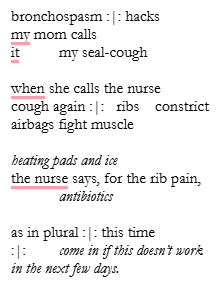
Another poem, “Bronchospasm” echoes the experience it describes both visually and sonically; imagine E. E. Cummings rewriting Ada Limon’s “Late Summer after a Panic Attack.” In “Bronchospasm” and others, Entler’s lines and use of white space reflect the poet’s intimate knowledge of breath. For example, the opening poem of the collection, “On Being Born a Lungfish,” indents the second and third lines of each stanza. Interspersed with poems built in couplets and tercets are both prose poems and poems like “Sixty-Five Roses :I: Cystic Fibrosis,” as can be seen in its first four stanzas below.
Just flipping through the collection, the variety of forms is itself exciting; Entler examines and challenges the structures of language in an attempt to express their lived experience. Thus, Entler uses all the tools available to break down the language surrounding pain. That is why this collection is such a force to be reckoned with.
There are two pitfalls that manuscripts about physical pain or illness must avoid. The first is that the speaker shouldn’t be defined by pain or illness; anything that centers the speaker as the victim or sufferer almost always falls into the second trap, too — sentimentality. Entler cartwheels past both of these. In the collection’s advance praise, Lauren Slaughter noticed this, too, and sees the speaker as claiming the language and illness as their own. This can be seen in “Why I Cringe When I Hear My Name,” where Entler makes the awful things family and friends have said to her her own by writing them like an incantation.
[…] twisting empathy into pity:
into I would never want your life.
into I would just give up.
into such an inspiration.
This list poem evades sentimentality, and its direct language doesn’t become pedantic either. If any poem in this collection were going to fall into the trap of sentimentality, it would be “What I’d Want My Child to Call Me.” There’s a moment in this sixteen-line poem in which the grief for a chronically ill body extends to all facets of life, including the future and impossible futures as well. The poem is about an imagined child, one who the reader and Entler know may never be possible —
[…] I’ll give whatever I can to hear
soft morning babbles turn loud and angry with hunger. For tears
and snot on the collar of every plaid shirt I own, and for sugary
breath of a kid learning to take what they need of language
and call me whatever they know to mean home and safe.
If we are meant to be the parents we needed, Entler certainly is. In these poems, Entler creates home and safe for herself, doing what they hope to pass on: an ability “to take what they need of language,” extending it to “home” and “safe,” we feel the experience of someone who has felt neither at home nor safeinside their own body.
Entler’s poems in Of Water Never Ceasing expand our understanding of pain in a way that cements Loblolly Press’ place in contemporary Southern literature. As mentioned, Entler’s voice is one that might have been previously overlooked. But by publishing this collection, Loblolly Press continues its pattern of expansive and inclusive work, along with collaborating with other small presses like Good Printed Things and raising money to pay the writers included in their anthologies. Indeed, if this collection is a harbinger of good things continuing to come from Loblolly, I’ll become too much of a fan to keep reviewing them with objectivity.






0 Commentaires