How to Write Directions to Your Own Grave: “Fights!” by Scott McClanahan https://ift.tt/o82df7Z
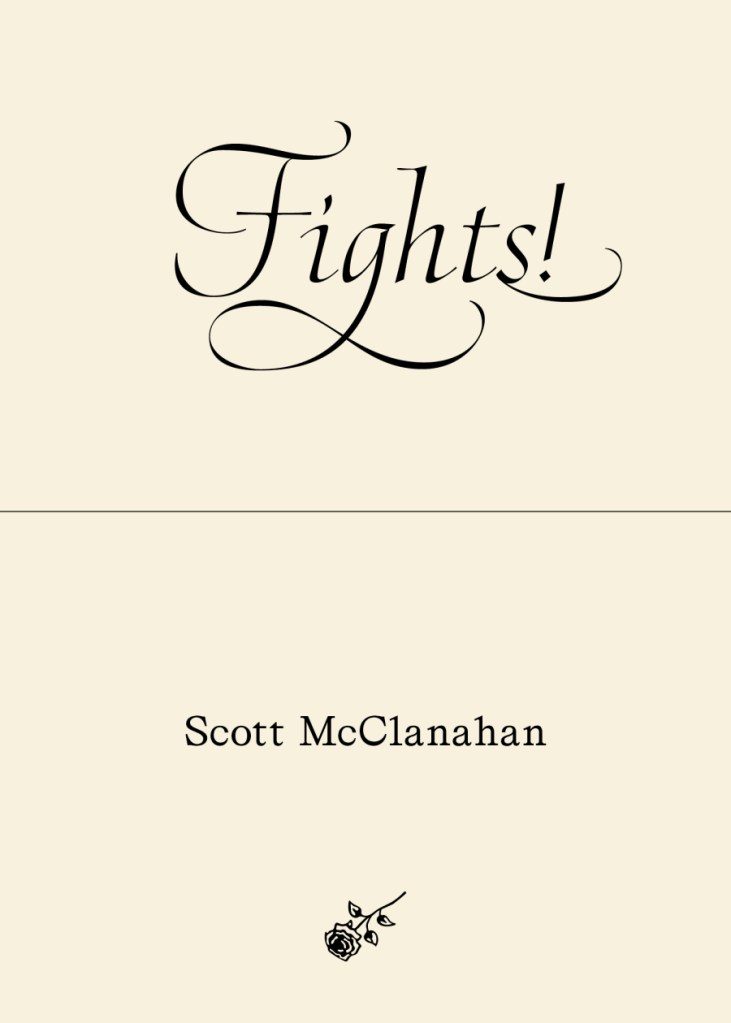
Scott McClanahan’s most recent book, Fights!, is immediately engaging. McClanahan’s unique and distinctive voice pulls us into and through vignettes that ultimately cohere into a narrative throughline. Fights! is set in both the mountains of West Virginia, as one might expect of a McClanahan book, and also in the New York literary scene. The book moves between two significant and somewhat intertwined relationships in McClanahan’s own life: with his wife, Juliet, and with his Tyrant Books editor, Gian. Fights! begins with Scott and Gian’s first meeting, and the tone throughout suggests that Gian is no longer with us, though readers (at least readers not inclined to Google the real Gian) cannot be sure whether this use of past tense reflects Gian’s absence from Scott’s life or from the world more generally.
In one anecdote, Scott and Gian visit the grave of legendary West Virginia writer Breece D’J Pancake. Though they have directions, they struggle to find the gravesite, and so they make a bet: “We should walk in opposite directions, and whoever finds the grave will live a long time, and the one who doesn’t will be damned to die an early death.” The results resonate through the rest of the book like an omen, and near the end, the narrator leaves us with a nearly blank page, saying, “I’ll leave white space here where the ones I love can write directions to my own grave one day.” Paired moments such as these bring cohesion to a somewhat episodic book.
Though it does feel as if Fights! presents real events, it does not read like a memoir. As is the case with other McClanahan narrators, the line between this narrator and the real Scott McClanahan is vanishingly thin. Other characters in the book are certainly based on real people — Juliet Escoria (Scott’s wife) and Giancarlo DiTrapano (of Tyrant Books) — and yet, what we come to know about them is necessarily inflected with McClanahan’s carefully crafted distance. Additionally, the episodic nature of the storytelling leaves gaps between events.
McClanahan’s earlier works, including Hill William (2013), Crapalachia: The Biography of a Place (2013), and The Sarah Book (2017), are characterized by a similar semi-autobiographical approach. In Fights!, the narrator explains the writing process for The Sarah Book, saying “I’d write down all the stories for Juliet and have her read them again. Then whatever she laughed at, I’d keep, and whatever she felt bored by, I’d cut. […] I’d let her edit my life.” It’s not difficult to imagine that Fights! may have been written in a similar fashion, pulling together the most compelling threads and editing carefully for engaging, resonant moments.
Despite its highly curated presentation, McClanahan’s writing comes across as genuine and authentic. Early in the book, the narrator explains that Gian “said he saw the video of my reading, and it reminded him of home,” and even though that reading was long ago, McClanahan’s writing still reminds me of home, too. Fights! was written between 2021 and 2025, but many of the reported events take place in the early to mid-2010s. In one scene, Scott and Juliet see “backpack people” in the parking lot of the “Scary Sheetz,” where someone else is driving an RC car around the gas pumps. Perhaps this could happen anywhere, but McClanahan sets the scene so vividly that he can only be describing West Virginia.
The structure of the book is another element that sets McClanahan’s work apart. I was delighted to find a second title page and dedication almost exactly in the middle. While this is not the first time I’ve seen a writer attempt such a structure, McClanahan’s iteration felt particularly well suited to the narrative and themes of the book. The shift is distinctly anchored to the narrator’s relationship with Gian. He imagines Gian’s feedback on the book, saying “I imagined him talking wild with his hands. His ghost voice said, ‘I dunno man, maybe you should just start over.’” Then the book starts over.
Fights! also delivers some particularly reflective direct statements that are likely to linger. In one instance, when Gian accuses him of being uncool, the narrator says, “I told him I didn’t want to be cool. I wanted to be warm” (90). Later, during a fight with Juliet, he reflects that “For the longest time, I thought the fights were in others, but now I could see the fight was in me.” These moments are not frequent enough to weigh down the narrative or become preachy, and perhaps more importantly, the book overall conveys an encouraging message about persevering in the arts and about legacy. McClanahan’s novel invites us to continue to fight “about what makes something real […] about what makes something beautiful.” Similarly, Fights! offers a sort of wish for every writer who has wondered, “Why did I think I could do this?”; may we all find our Gian, or rather, may he find us through the internet.
Fights! By Scott McClanahan Rose Books Published 14 July 2026




0 Commentaires