All the Birds and All the Grief in “All That Teethes Within” https://ift.tt/IJ7MoVG
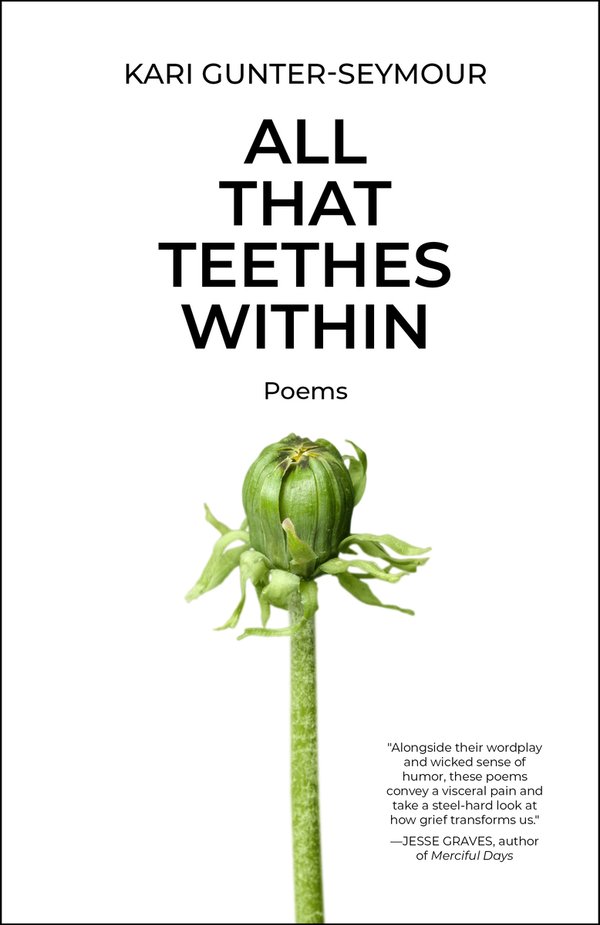
A speaker struggles to find words as she grieves her sister’s suicide in All That Teethes Within. Kari Gunter-Seymour’s poems sometimes crawl through muck and sometimes fly, carried by a simply stunning quantity of birds: this collection mentions hummingbirds, bluebirds, blackbirds, finches, robins, sparrows, roosters, kingfishers, crows, doves, and more. In the first of its three sections, however, Gunter-Seymour’s avian imagery takes on an ominous, repetitive, even obsessive quality. A bird breaks its neck on glass in two poems reflecting on the death of a sister by suicide: in “Today a Bird”, the speaker reflects that “a bluebird / flown headfirst into a window is beautiful / even in its stillness”; in “Oh Sorrow”, the speaker has “become a dark-eyed junco, flown headfirst into a plateglass window”. In “Next time someone else”, the speaker imagines telling the story of her sister’s death in terms of flight and transformation: “You deemed those pinions sanctified / blinked, swelled your phantom plumage / dove into a swoop and glide / currents swirling into deeper shadow”. The speaker expresses frustration at the compound loss of love and language: “these days my words lack enchantment. / Still, I sing my sister’s name like a spell”. Where language fails, she tries music:
I hum for those I have lost,
count stars between sunrises,
close my eyes, thumb past the strictures
that silence me, my sleep
sleeping without me, this land
both cradle and grave.
The second group of poems in the collection, subtitled “This land holds / every aching word I whisper”, explores the ways that we are tied to the places we love and the time we live in. A poem titled “After my sister’s suicide” explores Appalachian superstitions that attend death: “everyone knows death comes in threes”; “careful / with mirrors, no hats on the bed.” Several poems casually employ the anxious vocabulary of public discourse: “generational trauma”, “the brutality, the politics, / the way we white girls muddle it”, “socialist yearnings”, and “active shooters”. The speaker longs to break free of this discourse in “For Pity’s Sake”, where she demands, “Let me be unruly, escape while I can, / sneak off grid to this outback, / wooded, feathered, and bloomed”. She looks “to the foothills, find[s] comfort in their whispers” amid the hardships she outlines, as well as long-term regional struggles like resource extraction (“King Coal”) and modern life in floodplains.
Gunter-Seymour considers the resilience of people who are tied to a place, as in “Where I’m Coming From”. Her speakers frequently reference ancestors and the power of their lineage: “…thick skin be thick / and a woman like me was built / for muck boots, spade and trowel. Working in the soil, in a garden, is explored as a way to connect with “our covenants / carried on tongues, roots / braided”. As “piles of collapse and catastrophe / gash the landscape”, and a granddaughter is made to “build barricades inside her classroom”, Gunter-Seymour finds refuge in natural beauty and the “alchemy of survival” that is local plant knowledge. Yet the poetic voice continues to express frustration at her own perceived failure to articulate her inner life: “all my splendid sorrows / a string of garbled moans.”
In section three – “The days go over— / a raw wince of light” – we begin to see our speaker heal. At first she says, “I am angry—never lived any other way, / couldn’t have, never once first picked, / only picked over, picked upon”. The inarticulate quality of loss takes center stage:
tattered bouquets
of language
limp, cloying
she is gone
her body tendering
back to the soil
This healing speaker embraces contradictions and takes risks. She spreads diatomaceous earth to combat stink bugs and poisons “blue-black crawlies”, but also takes steps to ensure one bug’s survival by her sink during a lonely February and feels the regret of “a Steinbeck character – struggling and sullen / too broken by my own tightfistedness / to conjure a defense.” She expands her repertoire of bread recipes, as a metaphor: “Oh America. I have accepted your pasty pale excuse / of a loaf for way too long in the name of peace / and prosperity”; then she calls black-capped chickadees “adorably gangsta” and adds her “own brand / of arriba, arriba” as she joins a woman dancing to Shakira in Walmart. She recalls her past with gratitude in “I Wish I Could Remember Her Name”. She acknowledges a level of self-deception in the effort: “What is hope, except to reject / all we’ve been gaffed into believing?” She finally breaks down – not because of family losses, or “the countless / drowned in North Carolina, the endless body-bagged in Ukraine.” – but when her granddaughter’s cat dies. She has a dog with one eye, and hints, “It’s a roll of the dice / which of us will be first // to make an effort to rise, / the breeze hinting at winter.”
For me, as a Pickaway County, Ohio native, the flora of All That Teethes Within – yarrow and milkweed, Queen Anne’s lace and clover, chicory and teasel – make this poetry collection feel like home. As for fauna… it never occurred to me that this could happen, but the sheer volume of bird mentions tilts over from the sublime and into the ridiculous. However – putting that small quirk aside – Kari Gunter-Seymour has admirably memorialized a journey of grief from its inarticulate, shocked beginning, and written her way to a satisfying – though, of course, never final – emotional conclusion.
POETRY All That Teethes Within By Kari Gunter-Seymour The University Press of Kentucky Published October 27, 2026






0 Commentaires