The Impractical, the Unlikely, the Impossible: A Conversation with Angela Ball https://ift.tt/Wc2NiSh
“On the special phone for the dead / You saved me with your poem” writes Angela Ball in one of the poems in Steeplechase. In this newest collection each poem is a kind of telephone indeed, connecting us — asking us to listen in on — a world equally full of mischief and love. The poems do to reality what breath does to a balloon, giving it new shape from the inside out. Through leaps and revelations, the speaker of Ball’s poems shows how the boundaries between places don’t really separate them but shape how they come into relation with one another. Whether “in a honky-tonk burnt / by time” or fleeing “a sick room / full of a police reality show” every place encountered by the speaker carries its own insistence to hold her attention. The result is an unpredictable conversation between the body and the spaces the poet (re-)constructs. Longtime readers of Angela Ball and new readers alike will find Steeplechase to be an exciting collection of poems.
This interview was conducted over the span of a few days via email and shared document.
Angela Ball’s poems, translations and essays have appeared in Poetry, Oxford American, The Paris Review, Atlantic Monthly, Ploughshares, North American Review, The New Yorker, and elsewhere. She is the author of seven books of poetry, including Talking Pillow. The recipient of an Individual Artist’s Grant from the National Endowment for the Arts, she teaches in the Center for Writers at the University of Southern Mississippi in Hattiesburg, where she lives with her dogs, Miss Bishop and Boy.
Hey Angela! Thanks so much for taking the time to talk about your new collection, Steeplechase. It’s an incredible book — the poems offer a way to pay attention to the world and the folks who inhabit it in a way that feels honest and genuine, even when they’re playful and mischievous. To start us off, I’d love to hear you talk about that balance.
I really like your articulation of the balance between playfulness and directness (honesty). I grew up in a household distinctly lacking in playfulness — its flexibility and liveliness. We see it all the time in healthy young animals — role-playing and joking with each other. Play-fighting that means affection. Language, I think, needs that sense of play. Robert Frost, who was very smart about how poetry works, required one of two things from every poem: outer seriousness and inner humor, or outer humor and inner seriousness. He often thought in dichotomies of inner and outer — and that makes sense — who we are is always a combination of the visible and the hidden. I like trying to get more of the hidden part out onto the page. W.H. Auden says of W.B. Yeats, “You were silly like us.” I’ve always loved that statement. Yes, Yeats could be silly. His elaborate and seemingly endless pursuit of Maude Gonne shows that. But the root of “silly” is “sely,” which meant “holy.” Being silly means caring about the impractical, the unlikely, the impossible. And not fearing to be judged a fool.
I also think that the world’s great stories can be and are enacted everywhere — in Mississippi as much as in Thebes, in Hattiesburg as much as Athens. Derek Walcott knew that when he brought Homer to the Caribbean. I think it’s important to show proper respect for where you are.
I’ve never heard that story between Auden and Yeats, and I love it so much. It’s neat too because that “hidden part” you’re attentive to is bound up in so many particularities. My favorite poems in Steeplechase share that. I’m thinking about “A Hard Cash Sky You Can Touch” with its lines “One silo so dark / it must have won midnight / in a poker game.” With that poem based in the Mississippi delta, I’d love to know — how much has Mississippi as your longtime home shaped the poems in Steeplechase?
The Auden and Yeats “exchange” happens in Auden’s poem, “In Memory of W.B. Yeats” in this stanza:
You were silly like us; your gift survived it all:
The parish of rich women, physical decay.
Yourself. Mad Ireland hurt you into poetry.
More than any other book I’ve written, Mississippi has informed Steeplechase. It’s because I was driving one stretch of the state — the part between Hattiesburg and Florence — several times a week to see my partner, Mike, who was suffering from terminal cancer. To get to Mike’s house from Hattiesburg, you could travel on Highway 49 or on country highways. I mostly took the country way. I’ve always tried to notice things that others may find inconsequential. I found myself looking at steeples: leaning and straight, rusty or recently painted, proud or cast down. That’s where the book’s title poem came from. When I told Mike I was working on it, he said, “You have to call it “Steeplechase.” I like the connection between a race and my poems — the original steeplechases happened overland, with the riders chasing one another from town to town: from steeple to steeple. I like to think of the poems in that book as a series of incomplete arrivals.
I also like to think of the countryside as having a life of its own that may reveal itself to a careful observer. We often speak of famous cities that way — why exclude any place from importance?
I went to Indianola on purpose to try to understand it and its aura of sadness. Of course that’s an unfinished process. I believe that history soaks a place — that people’s thoughts and actions mark it, leave scars. Ideas like that one are behind the poem. My friend Steve Yarbrough inspired my visit. He grew up there, played football there.
Southeastern Ohio, where I grew up, is a poor, sad, rural place. My paternal grandfather farmed during the warm months, mined coal during the cold ones. The land supports dairy farms best, since the terrain is hilly. My father’s favorite musician was Hank Williams. I came late to understanding the brilliance of his songs — how they capture the sadness and fatalism of rural life. They are secular hymns.
There’s such a neat poetics in thinking of a poem as an incomplete arrival! Your treating of rural spaces equally as sites of artistic inquiry as the famous cities reminds me of your longstanding work on the New York School. There’s an interesting question of legibility there, right? Hank Williams’ hymns are legible to a certain landscape of experience, just as John Ashbery’s poems are. It’s neat to think that the speaker of your poems is experiencing these multiple landscapes — multiple ways of being — but they don’t feel in contention. Is that the surrealism in your work? Or is there a better word for what I’m describing?
If I am remembering correctly, John Ashbery once called NYC ‘a big empty space in which to write’. I love that description — it’s so counter to the usual view of the city. I think perhaps he was referring to the sense of possibility there. That nothing is dictated. Sometimes in a small town there’s a sense that what’s there has followed instructions: “Now we’ll have a pharmacy; here we’ll put a grocery store; here a hospital.” That has its charm — I think the title of Ashbery’s book, Breezeway, pays homage to it. The allure of the old model train sets. But NYC for Ashbery had the anarchy of emptiness: clear space for the imagination. I enjoy that feeling, too. I also enjoy exploring the constraints of particular environments.
In Steeplechase there are poems about women “confined” to a hotel or restaurant — by emotional need or the need to make a living. That confinement brings with it intensity. The place has determined a way of being. I like expressions like “putting the cart before the horse” – -often in life the usual, expected hierarchies are disrupted: dreams supplant daylight; obsession supplants routine. Donald Barthelme, in his brilliant essay “Not-Knowing,” says that there is only realism. I tend to agree. I love that you join me in calling Hank Williams’s songs hymns. They are! I guess that I am trying to read and reproduce as many “landscapes of experience” as I can.
Beautifully said. You brought us right into the next question too — is there a poem from Steeplechase you’d be willing to share the writing process on?
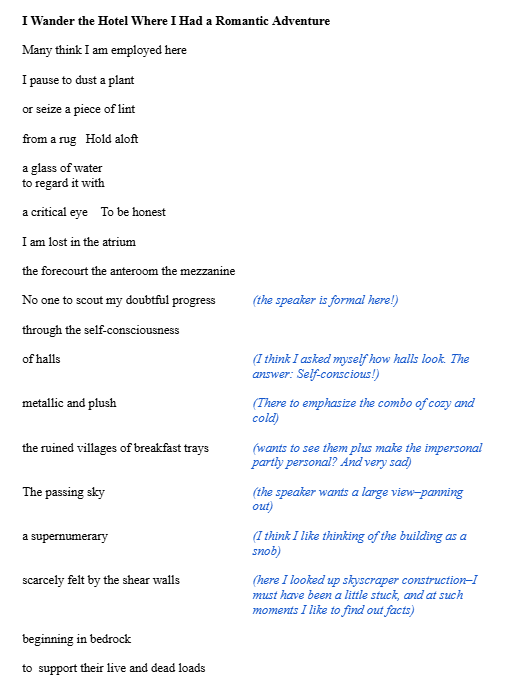
That question is a lot of fun. I could use a slightly better memory, but I think I can limn the process of writing “I Wander the Hotel Where I Had a Romantic Adventure.” I started with a vague idea of setting a poem in a hotel. I like spaces that are limbos of a sort. Jean Rhys said that she liked hotel rooms to be very impersonal, I think — ”resembling a restaurant” she said. The boundaries of public and private are interesting when they intersect. When I wrote the line “Many think I am employed here” I think it gave me the tone for the rest. The delicately possessive attitude of the speaker. I like that she “holds aloft a glass of water / to regard it / with a critical eye.” That’s sort of nutty, that courtly thoroughness. I like the parts of the hotel and how the speaker states she is lost in them, at the same time that she knows their names. I hear an echo of Kenneth Koch–I don’t know if I heard it at the time – from a favorite poem of his called “Permanently” — the first two lines of its last stanza:
As the adjective is lost in the sentence,
So I am lost in your eyes, ears, nose, and throat—
I love the combination here of lyricism and flatness — the switch to impersonal medical phrasing is so funny! I imagine that Kenneth might be part of my interest in playing with personal vs. impersonal.
What a gift to find out these weight classifications for buildings! The phrase seemed appropriately sad to me — the stark contrast between “live and dead.” What impersonality the building has!
Yet it has been the site of a “romantic adventure.” Somehow.
That last word might sum up how I write things.
What a great compound word! Somehow. It feels like the turn where uncertainty becomes full of potential — “the hectic and the breathless” to use a line from Steeplechase. As a final question, what was your favorite part of making the poems in Steeplechase?
Probably the way several were begun and grew on the way to and from Mike’s house, on the little road nearby where I took walks, and in his mom’s garage turned bedroom, with its screened windows that often admitted the songs of frogs and crickets. I became good at multitasking, sitting up in bed beside Mike with my laptop, rubbing his back in between drafting lines. “A Dish of March” is one I remember working on that way, with the TV on, as it was 24/7, as Mike needed it to be. His last hobby project (he took up assembling and painting precision models) was a 1/28th scale model of the Titanic. Fittingly enough, it remains unfinished, but I inherited a nifty little jeep with a soldier sitting jauntily half-in, half-out of it.
Thank you so much for this generative conversation and this insight into your newest collection Angela!
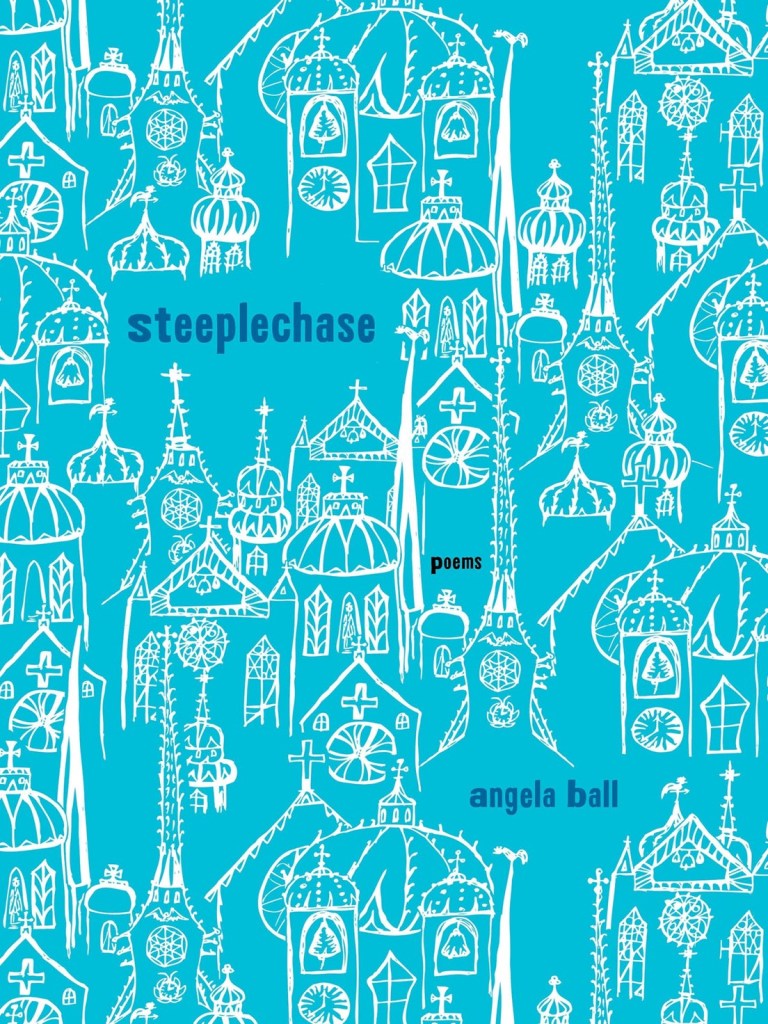
POETRY Steeplechase By Angela Ball University of Pittsburgh Press Published February 10, 2026




0 Commentaires