Humor, Humanity, and Southern Grit in “Daytona Teddy Riggs” https://ift.tt/dUzeoty
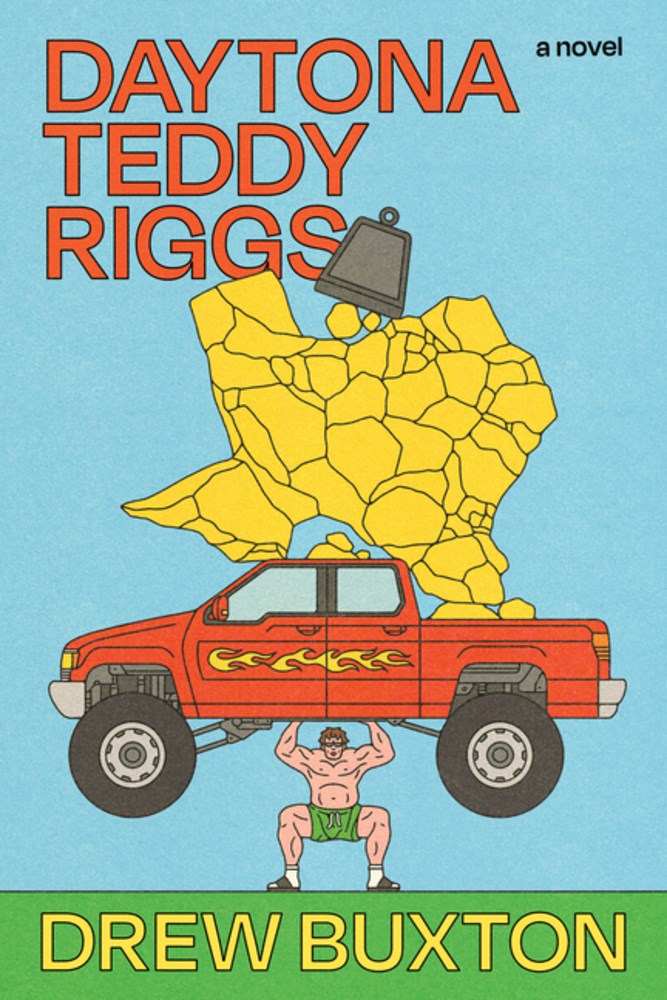
Maybe your summer has one last beach trip. And if it does, put Drew Buxton’s Daytona Teddy Riggs in with your towels. If characters from History of Heartache by Patrick Strickland worked out in a gym with the plot of Shome Dasgupta’s The Muu-Antiques, Daytona would be the spotter. In the tradition of A Confederacy of Dunces, this work of literary humor will make you laugh out loud as you consider the absurd. We get to be in on the joke about how ridiculous Daytona is, even though he doesn’t know he’s the punchline.
Daytona Teddy Riggs is a big guy; 6’6” and over three hundred pounds. His greatest glory was being a high school football star in Corpus Christi, TX before he scrubbed out in college. Now Daytona lives with his grandmother after his parents kicked him out. However, Daytona has goals. He’s going to be the world’s strongest man. But the path to that is not as straightforward as his self-help guru, Pat Dupree, would have him believe.
At first, Daytona seems unredeemable. The first scene of the book has him sneaking into a middle school football practice and laying out the quarterback to teach him a lesson about watching his blind side. When the coach takes offense, Daytona explains it away because this former coach knows, “the kids really listen to me and respect me, and they know he’s just some old burnout.”
Daytona should be financially set. He comes from a prominent oil family. But repeated run-ins with the law, paired with a poor sense of industry, are what land him with his grandmother. It is through his relationship with her that we begin to see the soft underbelly of a person that only wants to show strength. He is paranoid about her dying, checking on her throughout the book. It’s likely because he feels like she is the only one that loves him, despite her constant criticism of him.
This might seem to be a serious start to a funny novel. But it’s not long before Daytona’s misguided ambition takes us on tours of the better Whataburgers of Corpus Christi, highlighting which value meals can give the most calories needed for lifting. Self-reproach is alleviated by his compulsive “training” which involves lifting or dragging whatever heavy object may be in the vicinity. While his run-ins with the law are all due to his impulsivity (such as stealing the kids’ cancer donation jar from HEB), his responses are even more impulsive, and comical. When he is kicked out of his gym by his closest friends, he will need a way to continue the training. That means money. His hairbrained ideas to get cash lead him to someone who will be both his biggest fan, and his biggest failure, on his path to the World’s Strongest Man competition.
Tammy is all the things Daytona isn’t: self-motivated, reliable, calm, and open-minded. Which makes it more confusing as to why she takes a shining to him. Again, a character becomes a lens, bringing Daytona’s better qualities into focus. Understanding his lack of experience (in nearly everything), connecting to his drive to succeed in a dream, and aligning with him around fitness and strength, she lights a path for him. She also provides lots of opportunities for Teddy to evolve, even eliciting enough empathy from him to think about getting her flowers because “I should be more romantic like that.” Even with her kind, patient tutelage, Teddy can’t seem to figure out how to love her.
While this book kept me chuckling, it still lives in the Southern Grit Lit tradition. Themes of escaping the past while struggling with naturalistic determinism, overcoming poverty, and battling classism are layered through the pages. Drinking and drug use that is part of the hardscrabble nature of the South are on full display, though for Daytona, it is steroids rather than meth (like in History of Heartache). But this book adds a few new elements to the genre. Self-help culture is lampooned, and Daytona’s wrestling with it becomes literal as he is tackled by Pat Dupree at the end of the book. Toxic masculinity is one of main themes being parodied here. For all of Daytona’s “functional strength,” he can’t get his internal fortitude into shape. By the end we see what all those muscles are compensating for: Teddy just wants to be loved.
Despite all his mistakes, his poor judgment, his inability to navigate the real world, and his self-centeredness, it’s hard not to root for him. After all, if he can evolve, doesn’t that mean we can too? According to Daytona, “Yeah, the only way you change is through adversity. I’m making big changes … It’s time to grow up.”
It’s likely laughter will keep you turning these pages almost as fast as Daytona Teddy Riggs can clean out a pizza buffet, but the ending is solidly literary. Daytona is certainly different in the final pages. He has reached his goal, but in a completely different way than one would have thought. He’s figured out love is a reciprocal activity: “I wonder if I can use strongman, if it’s my gift to the world.” Clearly, he’s still Daytona.
FICTION Daytona Teddy Riggs By Drew Buxton Hub City Press Published August 25, 2026




0 Commentaires