“To revel in language”: A Conversation with Anna Lena Phillips Bell https://ift.tt/ebvVPna
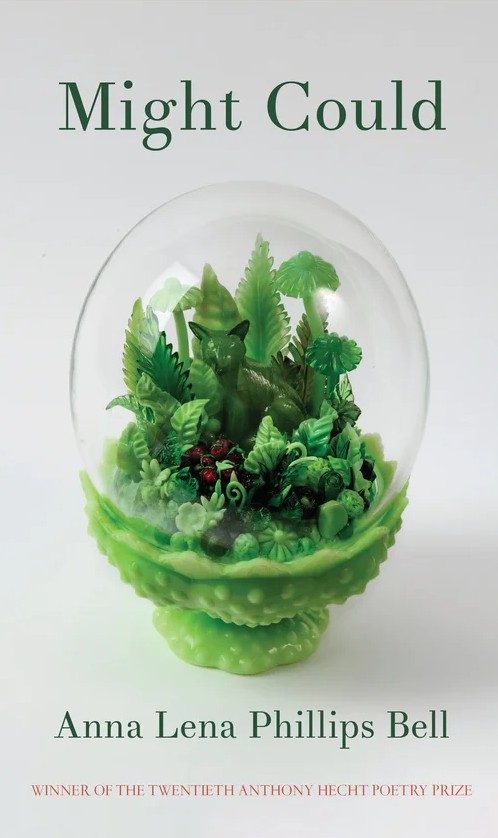
As a poet who uses meter and form frequently, I was instantly in love with Anna Lena Phillips Bell’s new collection Might Could. I wanted to understand how the formal elements of the work complemented or shifted the content of Bell’s poems. In the poem “Vase,” she writes, “The vase, as the earth / roots delve into, / holds close or loose / what it was made to.” This intensive use of rhythm and rhyme is typical for the book. But it is so much more than an exercise in form. I am spellbound by Bell’s language and imagery, at once welcoming and cautious, and the dialogue it creates with the landscape of a vibrant and polluted Southern river. In his foreword for the book, which won the twentieth Anthony Hecht Poetry Prize from Waywiser Books, judge Shane McCrae writes, “Anna Lena Phillips Bell emerges . . . as a poet who has discovered not only a new song, but a new way of making musicality the first concern of poetry.” Through its music and its insistence on paying attention to what’s around us, Might Could finds a way to imagine new life.
Anna Lena Phillips Bell is the author of Might Could, winner of the Anthony Hecht Poetry Prize, Ornament, winner of the Vassar Miller Prize, and the chapbook Smaller Songs, from St Brigid Press. New poems appear in West Branch, Poetry London, Poetry Northwest, Orion, and Ploughshares, and new artist’s books have been exhibited at Abecedarian Gallery, Asheville Bookworks, and End Paper Art Book Fair. Her work has received support from the Sewanee Writers’ Conference, Marble House Project, and the NC Arts Council’s Literature Fellowship program. Bell teaches at UNC Wilmington and is the editor of Ecotone. She lives with her family near what’s now called the Cape Fear River, and calls ungendered Appalachian square dances in North Carolina and beyond.
While writing this book, Bell was also working as the editor of Ecotone, UNC Wilmington’s magazine of reimagining place. And she was settling in to a new-to-her coastal landscape. Over email, we talked about editing poetry, using meter to evoke regional speech, and her miniature guide to fixed forms, A Pocket Book of Forms.
The first poem in Might Could, “Place Card,” is both an invitation and a caution to readers as we enter the book. What were you thinking of when you wrote this poem?
I wrote “Place Card” after an interdisciplinary artist residency hosted by Emily Larned of ILSSA (Impractical Labor in Service of the Speculative Arts). The first night, when we arrived for dinner, mari jaye blanchard, one of the residents, had hand-lettered place cards for each of us. I was so moved by this — everyone literally having a place at the table. As we introduced ourselves and talked about our artistic practices, I was moved too by the wildly different creative work everyone was doing. I’m drawn to a lot of kinds of making — poetry, letterpress printing, book arts, dance — which is really fun until it’s overwhelming. It was a relief to sit there and think, each person here is doing really good things, and I don’t have to do everything. I made the poem as a reminder for myself, both of my limits and of the feeling of being in right relation to work and community. Then my friend Malena Mörling read it and said, “It’s like you’re talking to a soul waiting to be born.” I like that reading too — I wanted that possibility to be present as the book began.
The book is filled with the more-than-human world. Can you speak to your connection with nature and how that relates to the poems?
Many of the poems in Might Could come from one place by a particular river. I wanted to show that place as truthfully as I could, to observe what’s beautiful about it even as I wrote about the increasingly violent hurricanes that affect this region. I wrote the earliest poem in the book sitting on the porch looking out at the river on autumn mornings the year my partner and I first moved here.
I’ve felt a kinship with plants since I was a kid, so being outside of town a little, where more plants are able to live and thrive, feels good to me. The scent the air carries is a big part of my feeling of well-being, and often, if we’re lucky, what we smell here is green growing things doing their work. Of course sometimes we also smell the less pleasant scent of a factory nearby — but that’s true in town too.
Throughout this book your use of sound and wordplay are captivating. I’m wondering how your interest in writing in various meters has contributed to your poetic diction.
I love the options meter offers — an array of structures to play with. The manuscript I’m working on now is a book of poems for the plant world, and in it I have a series that uses a lot of words created by an n-gram generator — words that sound like English but are not of this language. Meter is really helpful for suggesting how those novel words might be pronounced.
Another thing I love about meter is that it can sometimes allow a person to write with the language and rhythms of the people they grew up with. I realized after I’d finished my poem “Common” that the dactylic meter is helping out in this way. It requires the reader to pronounce the word “police” as “PO-lice,” or at least to give the first syllable more stress than usual: “Road is the oil dug up and laid down / Car is the police who speed back to town.” This is not how my immediate family would say it, but is part of the vernacular in the places I’ve lived most of my life. I was happy when I realized the meter was doing that work for me — un-erasing a nuance of language that would not otherwise appear on the page. The pronunciation also has a little defiance in it, to my ear, which I like. I have feelings about the police state, more so than ever, lately, and I did want to call out the police who speed up and down our road way too fast in the middle of the night.
You often use various kinds of rhyme — slant rhyme, eye rhyme, identical rhyme and true rhyme — both within the line and at the end. What is your relationship with rhyme, especially as a poet writing in an era where that technique is not as popular as it once was?
Rhyme is so fun, right? My two-year-old has recently discovered it, and has been going around the house chanting partly English rhyming phrases. Is poetry an excuse to keep doing that sort of thing well into adulthood? I mean, for me it’s one of the ways to revel in language, to see and hear what it can do.
In the poem “If I say you safe,” I went all in with monorhyme — if not absolute monorhyme, rhymes with the same closing consonant. That intensive constraint gave the poem the freedom to imagine what it would be like to conceive a child. It also lets the vowels really have their own kind of a time. How lucky that we have vowels! I have a little bit of synesthesia, the kind where letters and numbers have colors, and the vowels are the most vivid part of the alphabet for me, which I think is for a reason.
So, yes, rhyme is powerful. I’m optimistic that we’re overcoming the false sense that it automatically makes a poem too simple, or sentimental. Can we say we have in fact overcome this? Of course not every poem wants to rhyme, but there are plenty I love that do — poems by Patricia Smith, George David Clark, Melissa Range, lots of others. As A.E. Stallings wrote in her “Presto Manifesto,” in 2009, “the freedom to not-rhyme must include the freedom to rhyme.”
You use several French forms that people may not be familiar with — rondelet, rondine, bref double. How did you discover these forms and what fascinates you about them?
I first encountered the French repeating forms during a college class with Carolyn Beard Whitlow. I love that they are so similar and yet so various, and I love their repeating lines. Probably in that same class we read Paul Lawrence Dunbar’s “We Wear the Mask.” I felt awed by it. At the time the idea of making another rondeau felt impossible to me. But I just hadn’t found the poems of my own that needed the form yet.
Years later I was writing a travel-sized guide to poetic forms, A Pocket Book of Forms, which I hand-set and printed during a letterpress residency for emerging artists at Penland School of Craft. I made some of the French forms its center spread. So when I did have poems for which those forms were a good fit, they were there waiting for me.
I’d love a copy of that book! I saw that it’s sold out — any chance of more printings?
The edition I made was a big one for letterpress printing, almost three hundred copies. Rory Sparks, the master printer I worked with at Penland, helped me over the finish line, staying up late in the studio with me to print and trim. But of course that’s a small run by traditional publishing standards.
I’m working to revise and expand the book to include more forms, sample poems in those forms, and a section on meter, but still to keep it pocket sized. I think poets deserve an analog guide to form and meter that’s easy to bring on adventures. I’ll keep you posted!
When you use a particular form, how does the content of the poem work with or rub against that form? For example, in “Bref Doubles for a Late Conception,” the crown that frames this book, how did form and content work together as you were writing?
I really like the productive tension of poetic constraints, especially overt ones like fixed form and meter, but also procedural constraints. In the case of the crown, I had recently put out a call for poems in fourteen-line forms for Ecotone. We were working on an issue with the theme of love, and Elliot Smith, our nonfiction editor and a student in UNCW’s MFA program at the time, had suggested that the poetry in the issue be all poems in fourteen-line forms. The Love Issue is still among my favorites. And it’s how I encountered the bref double — looking for additional fourteen-line forms for that call for work.
The bref double is a funny one because it elides a lot of the structure of the sonnet, while keeping its shape and keeping some rhyme. The rhyme doesn’t all have to fall at line endings, so it can be subtle or sly. It seemed like a good form for states of unknowing, which the experience of trying to conceive definitely is.
You’ve been the editor of Ecotone — which calls itself the literary magazine that seeks to reimagine place — since 2013. Are there other ways in which your work as an editor affects your poems, and vice versa?
Thinking deeply about a poem with someone else is so much fun. I love that that’s just part of the editorial process. Not that my thinking always results in an edit — sometimes I’m writing to say, we’ve read this carefully and didn’t see any changes to suggest. But other times I do see things, and sharing them with the writer and hearing their response is one of my favorite parts of my work. As an editor, I get the chance to work with poets on kinds of poetry I would never write myself. It expands the field for me.
The internal conversations we have at Ecotone are also a pleasure — I really enjoy thinking with my colleagues and students about acquisitions and edits for poems, as well as about how to sequence them within an issue. There is such love in the room for the work we’re publishing in those discussions. And seeing a new editor draft their first acceptance letters and then their first editorial letters gives me hope for the craft.
As a poet, I’m always thankful to receive edits from a sensitive and knowledgeable editor, especially one who knows how to read and offer edits on metrical work. The editorial board at Waywiser Books was really helpful as I was resolving some last questions I had about the manuscript. Jessica Faust, at the Southern Review, has been marvelously helpful to every poem of mine she’s edited. And there are many other magazine editors who’ve helped me settle a lingering question about a poem, or noticed something I wouldn’t have.
I want to go back to the crown of bref doubles. How did you decide to build the book around it? How does that sequence weave into the other themes of Might Could — the versatility and resilience of the more-than-human world, the necessity of nature to one’s life, the power of the everyday to lead to epiphany if we pay attention?
I love how you’ve described those themes. At some point, as I was putting the book together, I realized that the poems that make up “Bref Doubles” should move through the text rather than being in one spot. I wanted the book to touch on trying to have a kid without being overtaken by that subject. And those poems, even though their primary concern is the effort to conceive, are by necessity about the speaker imagining bringing up a child in their particular part of the world.
To the list of concerns you made, I would add the power that industry and government exert on us through neglect, which is tied up with another thing I think about a lot: how to make a good life amid the slow violence of human-caused climate change and other environmental trauma. Our wellwater here is contaminated with multiple PFAS chemicals; the municipal water for our city is too. We’ve invested in a filter system, but I worry it’s not enough. These chemicals are not detectable in water by human senses. We only know they’re here because of the efforts of the journalists and scientists who’ve devoted themselves to the issue. The problem is so bad that the UN’s Human Rights Council has investigated it. I still feel kind of shocked by how closely that violence touches my life, in ways it didn’t seem to when I was younger. This is not only because my family and I moved to a place farther downstream and more contaminated than many. It’s that the dangers we all face are accelerating and intensifying.
And what are we going to do about it next? What more can I do now? It’s more challenging to keep asking when you’re worried about whether your water will make you sick. Writing poems helps me keep my attention where I want it to be: on those questions of what to do and how to act, and on the things that I love and that sustain me — my family, the plant world, my community. Poems can’t be the only answer or the end of action, but they can help.
POETRY Might Could By Anna Lena Phillips Bell Waywiser Books March 1, 2026




0 Commentaires