Maria Enrqiuez on What Cemeteries Have To Teach Readers About Life https://ift.tt/v6k8T3U
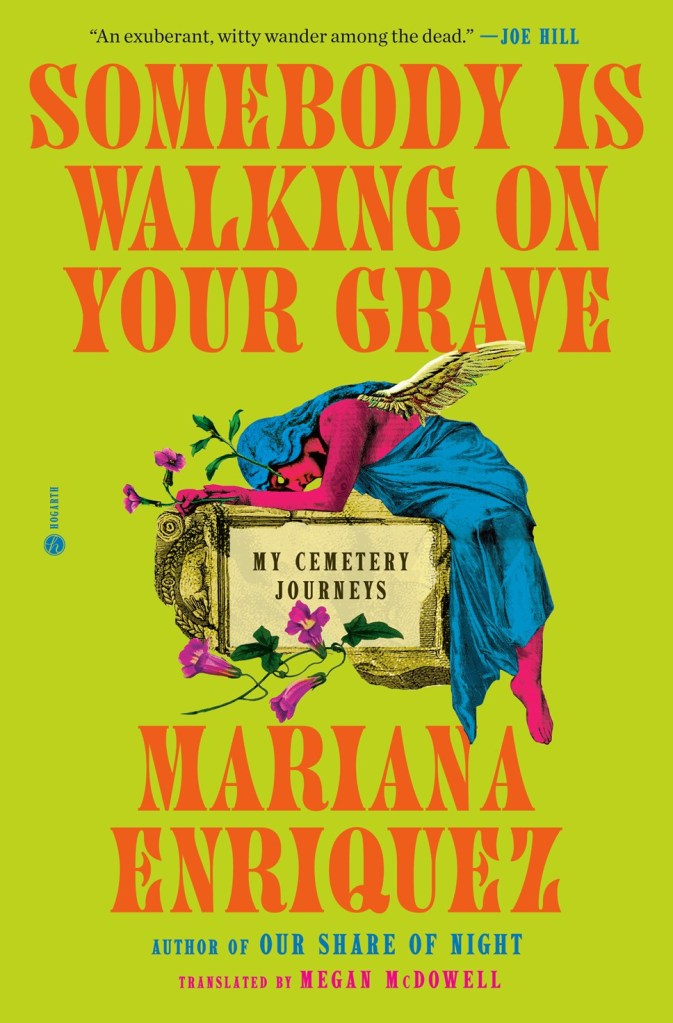
Reading Somebody is Walking on Your Grave by Maria Enriquez compels a confession from me: I wish I’d managed to keep detailed journals over my lifetime — the kind that are required to write about my travels as a memoir enriched with history and fascinating details.
Enriquez’s book dedicates one chapter per location, and some places include more than one cemetery per story. Chapters span from the mid-1990s until 2020, but aren’t in chronological order. This nonlinear movement through her life and places she’s visited creates momentum. It also highlights stories about the lives of people buried and pinpointed in a time and place different from our own. Some stories include historical occurrences with lurid detail, accentuating Enriquez’s world-building ability. She describes locations in her past, which by now are themselves changed. She describes the stories of the dead. She’s able to do this through an attention to detail married to contextual knowledge.
I found this book aspirational both as a writer and someone who’s traveled a lot. In fact, the chapter describing a trip to Australia, where I was born and grew up, is a testament to how well Enriquez can make a place vibrate on the page. “A Bar in Broome,” takes place in Western Australia, the same area I visited decades ago with an ex-boyfriend, eating in one of the neighborhoods Enriquez stayed in, making the same island visit on that same ferry route. I felt the queasy gift of being on coastal Australian waters, so much so that I had to recheck whether I’d conflated my memory with her ability to tell a good story — she doesn’t use the word ‘queasy’ but references the feeling well enough that my mind did the rest of the work.
In the same chapter about Australia, Enriquez questions her boyfriend about a cemetery they pass by one evening on a quiet, suburban street. She’s unused to cemeteries without walls. His answers and her descriptions were so evocative of the country where I grew up that I realized I trusted her writing choices of which specific and sensory details to include. She writes with embellishments that work but don’t clog the text. The writing is rich yet balanced.
Megan McDowell’s translation work on this book came to the forefront of my mind when reading the Australia story, specifically the relationship between writer and translator. The cadence of conversation with Enriquez’s Australian boyfriend and other locals was first written and described in one language. Then McDowell transports it into another. This includes the local vernacular, sense of accents, and attitudes of the people speaking. Enriquez’s writing talent feels compounded by being translated.
Other trips I’ve made crisscrossed with Enriquez besides Western Australia. It was strange irony to realize that when I was patting the foot of Grey Friar Bobby’s statue in Edinburgh, she was there too. I remember hurrying past the Edinburgh Book Festival tents in 2017, the same year Enriquez was attending, while running errands and attending the Fringe. Such a vast array of history and places and people yields stories that many readers have associations with. Whether or not we ourselves have visited these exact places, we may have experienced similar thoughts and responses elsewhere. Enriquez creates connectivity from seemingly bizarre details.
The structure of the book lends itself to creating a memoir that evokes our own experiences. On one hand, we don’t conceive that everybody has an intense fascination with cemeteries, and yet when reading this book, I come to believe we do. Enriquez understands how to place her experiences in the context of the history of the place – in this case, the cemeteries and the people who are buried there. She describes how sometimes people are removed and placed elsewhere, a surprisingly common feature of cemeteries. There’s a subtle yet palpable parallel undertow throughout the book that speaks to the displacement of the living.
The book is detailed, strange, yet fun and light. The stories don’t look at death with only grief, but allow darkness to lurk and breathe. There are some rather shocking details, but they’re not gratuitous. It’s another point of admiration and perhaps a little envy, when I think about the skill it takes to develop setting and history so that it cradles the macabre so naturally.
By sequencing her chapters as scattered destinations travels with an enduring theme, Enriquez’s book is a luxurious read in addition to being a reference guide for cemeteries. It reminds me of how we navigate by our interests — what draws us to a place is unique to each person and equally valid.
In this book, Enriquez’s balances the gravitas that comes with walking among gravestones with her acute attention to detail. Perhaps because the book delves into the lives of people through the prism of death, it encourages writers to consider how to be in the present moment wherever one happens to be traveling.




0 Commentaires