Sex, Shame, and Religion in Deesha Philyaw’s “The True Confessions of First Lady Freeman” https://ift.tt/FKg1hxa
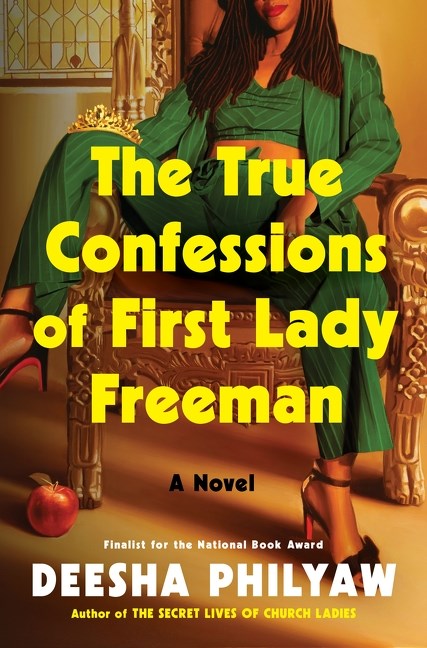
Deesha Philyaw’s fiction—first her award-winning 2020 story collection, THE SECRET LIVES OF CHURCH LADIES, and now her debut novel, THE TRUE CONFESSIONS OF FIRST LADY FREEMAN—is distinguished by how boldly she writes into the center of a Venn diagram where many people are often afraid to go: sex, shame, and religion. (As I write this, I feel like Philyaw’s protagonist, the eponymous Scharisse Freeman, is cracking a joke in my ear about how much the shape of the center of a Venn diagram might evoke the same “dewy center” her pastor-husband David enters with “the grace of a majestic elk” in a bit of erotic Jane Eyre fanfiction she conjures up in the company of her vibrator named Wanda on the night of her fortieth birthday bash.)
Set on the outskirts of Atlanta, THE TRUE CONFESSIONS begins with a somewhat frothy if enjoyable premise featuring a beauty pageant for a clique of well-off, middle-aged Black megachurch pastors’ wives, also known as First Ladies. Our hero and first-person narrator is the delightfully irreverent and sex-positive Scharisse, or Schar, who is desperate to win the pageant in the hopes of being accepted by the other First Ladies.
Though Schar has been a First Lady for nearly twenty years and has built a minor economic empire trading on her identity as such (her own brands of salad dressing and dishware, etc.), she has always felt like an outsider in this community. In particular, she feels looked down upon for growing up on the east side of town, where women were labeled “easy” by their churched west side counterparts. She’s been careful to guard key details about her family of origin, specifically her late mother, from the other First Ladies and even her husband, out of shame.
Philyaw’s style, as channeled into Schar’s character, is exuberantly over-the-top and a pleasure to read. The book’s dominant vibes are reflected in the following lines: “I tugged at my pink Oscar de la Renta petal-appliqué organza mini-dress. I looked like a giant flower, in a good way. Inhale nerves, exhale bad bitch.” Philyaw sprinkles in many witty Scriptural references that will be especially delicious for readers who have secret past lives involving Bible study groups, or who wore WWJD? (What Would Jesus Do?) bracelets in the 1990s, though she provides explanations to make that aspect of the book more accessible to other readers. There’s also some loose formal experimentation as Philyaw inserts the occasional footnote, email exchange, pageant schedule, and even a brief play in three acts. It’s chaotic at times, but fun.
However, Schar’s light-hearted send-up of the pressure she feels to be the ideal “Proverbs 31” woman soon gives way to a more complex story with much higher stakes. Secrets connected to her mother’s death related to AIDS come to the fore and complicate her participation in the pageant, expose cracks in her marriage, and threaten her standing in the community at large.
It’s at this point that the novel’s true concerns come into full view: the mechanisms by which male perpetrators are so often protected and women who are victimized are blamed or erased, and the role that shame plays in keeping people silent in the face of injustice. While Philyaw’s critique is specifically aimed at Black evangelical church culture, Schar’s story has tremendous relevance for any context in which people are confronted with a choice between protecting institutions and people in power or seeking justice for those who have been victimized, no matter the cost.
Few contemporary writers of literary fiction even touch the world of religious faith, much less take such a deep dive as Philyaw does here. The strongest recent exception that comes to mind is Addie Citchens’ 2025 debut novel DOMINION, which likewise explores toxic masculinity in a Black church community and features a First Lady as one of its two protagonists. Both writers make a masterful use of voice, place women at the center of the story, and bedazzle their crisply constructed plots with some formal playfulness. Where THE TRUE CONFESSIONS diverges is in the remarkable variety and nuance of its villains, as Philyaw offers us a deeper inventory of the many forms that complicity and culpability can take, regardless of gender.
Along these lines, one of the novel’s greatest strengths is the complexity of the character development. This is most apparent in Schar’s closest relationships, such as the evolving portrait of her marriage as she tries to sort out whether David is as good for her as she wants to believe. Her relationship with her daughter Gabrielle, whom she describes lovingly as “the world’s most uptight almost-seventeen-year-old, who would hover in judgment over my decision to wear false eyelashes,” is also richly drawn and adds an important layer of reflection and personal consequence for Schar’s actions.
The immediate family drama is supplemented by compelling secondary arcs involving two of Schar’s oldest friendships, each of which becomes fraught in its own way. Other secondary characters who first appear to be caricatures—like the sanctimonious Sister Sheila, who peer-pressures Schar into destroying her oldest friendship, or Schar’s rival Daphne, who has built a brand around forgiving her cheating husband, and even the cheating husband himself, who plays a starring role in blowing up Schar’s life—consistently get their due and depth of shading as the book progresses.
Most importantly, Philyaw is not afraid to make Schar just as vulnerable as these other characters to the pressure to try to protect herself—and by extension, the part of the Venn diagram where her personal interests and the church’s institutional interests overlap—at the cost of her own integrity. The novel that results is both highly entertaining and morally incisive.






0 Commentaires