Surrealist Play and Cultural Betweenness in “The Lighthouse Tattoo” https://ift.tt/pHlQOXn
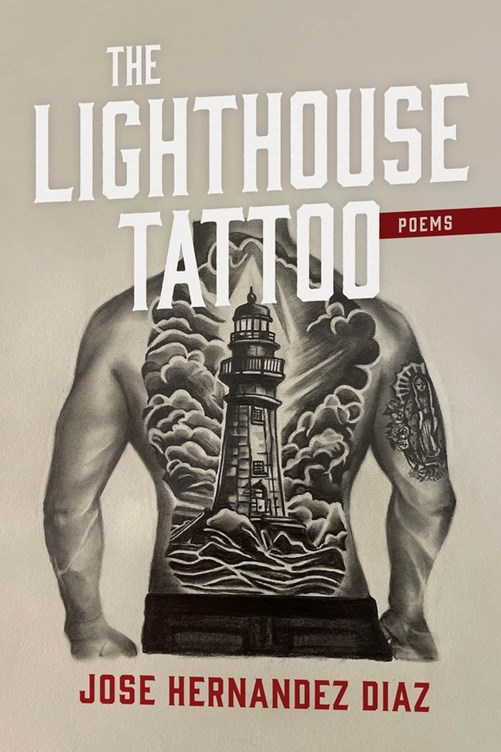
When you started reading poetry, did you follow the Poe to Plath pipeline? Did you earnestly clutch your first Mary Oliver or Ross Gay collection to your chest? Or did you make your meandering way from a child’s volume of Shel Silverstein to Apollinaire to James Tate, admiring their sparkle and smirk, colorful characters, and surprising pathos? Fans of Tate and Russell Edson should follow their literary sidewalks to Jose Hernandez Diaz and his new collection, The Lighthouse Tattoo.
Preexisting fans of Diaz will find many themes borrowed from his prior chapbook, The Fire Eater (Texas Review Press, 2020) and collections Bad Mexican, Bad American (Acre Books, 2024) and Portrait of the Artist as a Brown Man (Red Hen Press, 2025). However, where in Portrait the speaker delivers a range of odes, the only ode in Lighthouse Tattoo is an “Ode to James Tate,” in which the speaker is asked to share his favorite poet:
There are too many to name, the day too short,

     The beach too vast and free to think about

Anything other than riding a longboard

At sunset, flying a kite in early spring,

     But since you are holding a gun to my head,

I guess I’d have to say, James Tate.
Seemingly flippant, this tension — the gun to the head — follows The Lighthouse Tattoo’s theme of pressure and influence in contemporary artmaking.
Pecuniary contradictions and the hypocrisies of artistic success take center stage. Diaz shies away from contemporary writers just as he does from historical greats: “Aesthetically, I avoid famous writers, like Mary Oliver or Billy Collins, except I’m secretly a huge Billy Collins fan.” With a wink and a nudge, he says, “If I get discovered one day and reach fame, I hope it will be on my terms. Or at least until I get tenure. Until then, it’s whatever the department wants. Ultimately, it’s just about dollars and cents, amigo.” Elsewhere, he aphoristically notes that, “Cellists are underrated. So is cash.” Monetary success and the “ease” of being “square and suburban” seems to trouble Diaz, whose “Aztec Gods” “jinx” his speaker and make his credit card decline when he tries to pay for a haircut — only for him to receive “a prestigious poetry prize” and rush to pay the barber shortly after.
But Diaz makes sure we know that artmaking has its own inherent draw, that it is born from dreams along many axes, as communicated in “The Fortune Teller of My Youth” (“after Mary Ruefle”):
When I was young, a fortune teller told me I’d slay many dragons with nothing but a silver rose. The fortune teller told me I’d bring great pride to my family, building a baroque castle for all of us to reside in. The fortune teller, whom I met in a peaceful dream, said I’d fly amongst giants but retain the heart of a lamb. Sometimes, I think of this fortune teller, at the dawn of autumn, when the leaves begin to turn brown, and the thick fog obscures the midnight moon.
The work also offers a way of being seen, albeit at a cost: in “The British Phone Booth,” a speaker is trapped inside “one of those old red British phone booths from the past.” When he’s able to escape with his fists, it is to “transform into a Shakespearean marionette, tights, trunks, facial hair and all. I recite the famous sonnets to the eager crowd that has gathered. I’m visible again.” While open to a range of interpretations, this felt like an allegory for escaping a colonial Anglophone culture’s confinement by one’s own power, only to be made an entertainment — but at least one who receives applause.
Diaz seeks to escape the troubled “artist” moniker altogether by sliding into increasingly prosy poems led by auto-fictional speakers, a classic James Tate gambit. Diaz distances himself from all but temporary identities using the same “man in an X shirt” formula that he’s used in other collections. There’s also a wonderful fabulism in the poet’s claim that he “was a professional surfer in another life. / Or a boxer. A pugilist, I should say. A writer is a curse.” He doubles down in “El Boxeador”: “I’ve been a boxer since I was five years old. I grew up on the southeast side of town. No one really wants to live here except us Mexicans.” His father tells him, “‘We come from an Aztec warrior class. Boxing isn’t a sport, mijo,’ he’d say, ‘it’s a religion. The boxing Gods don’t forgive.’”
In this way, Diaz expands on formal territory occupied by Tate. Where Tate explored a self divided by loss and psychological disquiet, Diaz’s persona work introduces surrealist play and narrative into a self divided by class struggle and cultural betweenness. In “Ni de aquí, ni de allá: Ni de la pinche luna,” Diaz speaks to the difficulty of navigating the literary world with equal facility in English and Spanish:
If we write in Spanish, we are foreigners.
If we write in English, we are assimilating.
If we write in Spanglish, we have no class.

If we put accent marks on our names, we are trying to prove a point.
If we do not put accent marks, we have once again assimilated.
In this funny, canny collection, Jose Hernandez Diaz uses his influences — at least their techniques, blessed by the broader institution of poetry — to subvert and expand on what surrealist expression is capable of, politically and psychologically speaking. Poems speak to Freudian internal conflict, but also the joy of a penguin ballet, “riding a longboard / At sunset,” family, and horchata ale. At a soccer game, the “the man in a Chicano Batman shirt” scores two goals and “his team celebrates by jumping up and down and chanting in a circle.” Diaz’s collection takes a step past James Tate’s to celebrate multicultural identity using dream-logic, symbols, and shibboleth.
POETRY The Lighthouse Tattoo By Jose Hernandez Diaz Acre Books Published November 15, 2026




0 Commentaires