“Hot Wax”: A Road Trip Worth Taking https://ift.tt/bjDtq5f
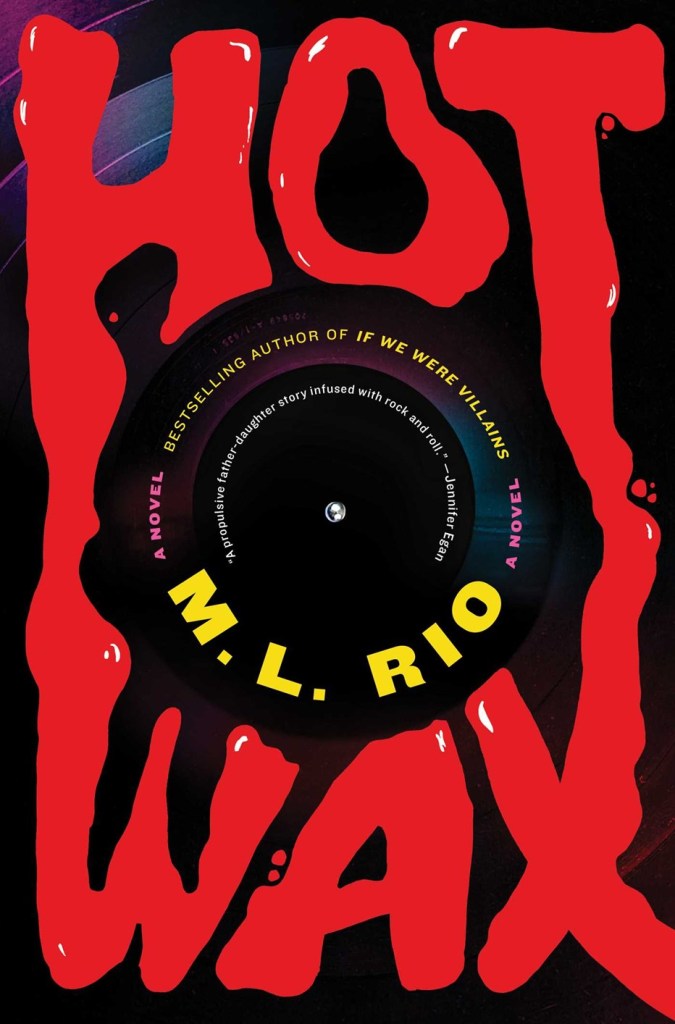
We all know the power of good music. We’re familiar with the emotional rollercoaster that a good song can take you on. The beats, the lyrics, the pulsing anticipation. These elements, and so much more, are captured in Hot Wax, the sophomore novel by author M.L. Rio.
Hot Wax spans decades, but it focuses on a singular protagonist, Suzanne, during two major timelines. “Side A” tells the story of Suzanne, a child of divorced parents, who is taken on a rock band tour when she’s eleven. “Side B” takes place nearly thirty years later, when Suzanne, now a forty-year-old woman, is simultaneously experiencing an apparent midlife crisis and reckoning with what she went through that summer on tour with her father and his band, Gil and the Kills.
Rio adds other snippets of story in chapters called “snapshots.” These interludes introduce outside storylines — her parents’ first meeting, Suzanne’s teenage years, Suzanne’s wedding — that fill in blanks but don’t follow the same timeline as either of the two main plots.
In Side A we are introduced to a spunky little girl who deeply loves her dad and wants more than the brief moments of time he can give her. Suzanne is raised in a chaotic home with more fighting than peace, but when her parents divorce and her mom remarries, Suzanne is able to spend more time with her dad, touring with him and his band for a summer. Her crucial role on tour is that of navigator: “…the creases in the map made a grid like a chessboard that spanned the whole city, each important square and the ways between them shaded with crayon from the mug on the counter or the stash of points and stubs crammed in Suzanne’s backpack.” This is not a role she ever really leaves behind.
In Side B Suzanne has just left her marriage. In addition, her dad, the infamous Gil Delgado, has just died, and her inheritance is the old Ford Ranchero he decked out and souped up over the years, plus a box of long-forgotten but important memorabilia, including the waxy stubs of her crayons, her trusted navigating tools. Ultimately, her dad’s death is her escape from her own — maybe not literally, but metaphorically.
Suzanne, we learn, has lost herself over the years. A fractured childhood leads to a fractured marriage leads to a fractured woman in search of herself and a past she hasn’t yet contended with.
When the Ranchero breaks down within the first few days of her great escape, Suzanne meets Simon and Phoebe, a couple with an Airstream full of antiques and flea market specials ready to be sold and traded. She enters a relationship with the pair and begins to feel a spark of life again; that is, until Rob, her husband, takes matters into his own hands and decides he’s not ready to let Suzanne go.
Suzanne flashes back to the summer she lived a life no child could thrive in. The drama of the dual timelines runs in parallel. Memories filter into the here and now, and the stable support of Simon and Phoebe enables Suzanne to come to terms with the past that has held her back from so much of her present.
It’s true that the story has multiple plotlines to follow and timelines to navigate. While some reviewers took issue with a few choices made by Rio, especially the occasional switch to Rob’s point-of-view as he chases Suzanne through the South, I’m inclined to trust the author had her reasons for including his perspective. Perhaps we need to be in his mind to understand what losing Suzanne was like for him, and why he was propelled to chase her across the country. Or, possibly, it is a device Rio uses to create tension and chaos. Regardless, what cannot be denied about Hot Wax is Rio’s uncanny ability to capture the grit, trauma, and instability of Suzanne’s life as we navigate multiple decades.
But it is truly the atmospheric writing of the music and of the 1980s that sets this book apart:
A shattering frenzy of strings and percussion. The crowed weltered and roiled and roared from their guts, seething like magma squeezed up through the Earth’s crust. Suzanne was paralyzed, brimming with an unfamiliar thrill. It was coming off everyone now, that pheromonic haze of bodies grown hot to the touch. Girls on the floor squealed like piglets, grown men in the wings shifted and flexed and sniffed the air.
Rio has mastered the ability to carefully construct each word and sentence and paragraph with cadence and rhythm. The sounds, the smells, the texture of dust and sweat — it’s all laid bare on the page. Music is already such a universally immersive language, and Rio did not disappoint when she set us on this rocky and winding road trip.
And at the end of the day, you can’t help but be enamored with a book that offers up lines like this:
West of Fort Worth the hours crawled by, sticky and slow as tar on the asphalt, Blondie dragging the Lifeboat through barely-there towns and thirsty oilfields where skeletal steel derricks pecked at the parched earth like starving birds.
None of this should come as a surprise, though. In 2017 Rio wrote the international bestseller If We Were Villains, and though she followed it up in 2024 with the novella Graveyard Shift (reviewed by us here), diehard fans have been eagerly awaiting more of her intricate prose.
Hot Waxis, as the kids say, a vibe. It is a season and a sound. An exploration and a discovery. It is a crucial step to self-discovery, all the while paying homage to the critical elements that make us who we are.
FICTION Hot Wax
By M.L. Rio
Simon & Schuster
Published September 9, 2025







0 Commentaires