“Ballot”: The Stakes of American Voting Are Higher Than We Think https://ift.tt/cfHkPmn
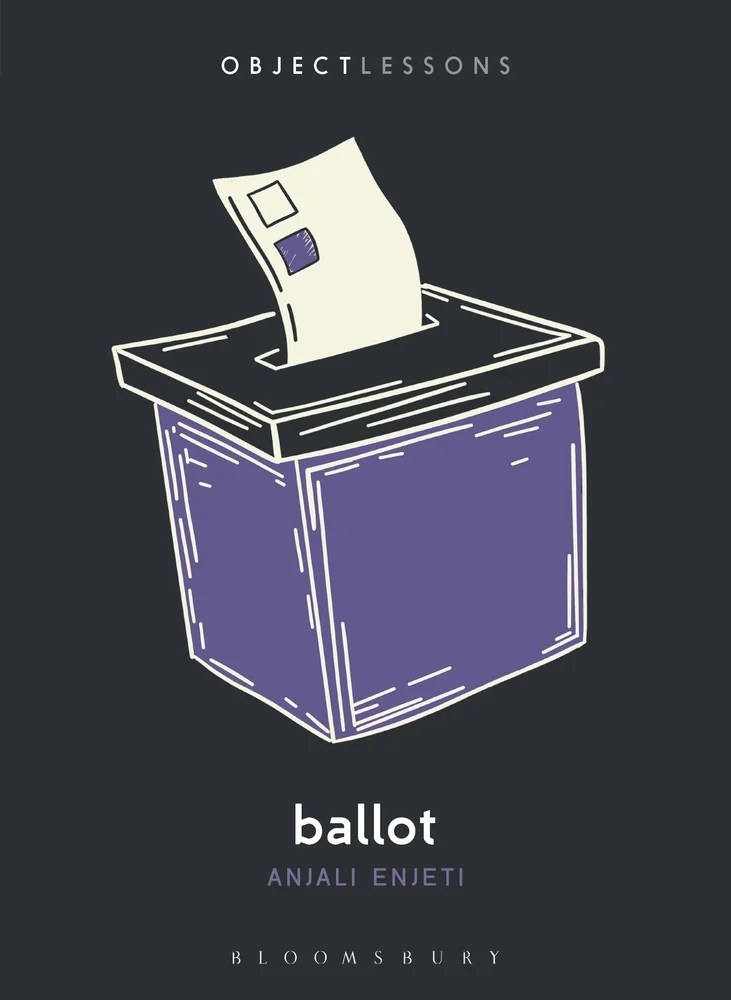
Ballot, Anjali Enjeti’s entry in the Bloomsbury Academic “Object Lessons” series, packs detailed information and emotional resonance into few words, and at the same time, the book conveys important and timely insight into the democratic process in the United States. The well-crafted sentences and punchy paragraphs are crucial for the level of emphasis this topic deserves. Even though I was already reasonably well-informed and largely agreed with Enjeti’s points, I couldn’t put it down. For those who are less politically inclined, the book may offer a new understanding of this seemingly commonplace process and its objects.
Ballot begins with a compellingly interwoven personal and political history: a story about the first election the author remembers is followed by a brief timeline, tracing her participation in the democratic process. Regardless of age or level of political engagement, most readers will remember one or more of the moments Enjeti highlights. The first chapter concludes with a powerful direct statement of Enjeti’s claim: “If we, as a nation, believe in the importance of free and fair elections, we’re going to have to fight harder than we’ve ever fought. We’ll need to reckon with some jarring truths, and find a new, more whole, more humane path forward. The future of US elections looks grim. But the battle for the ballot marches on.” This claim is consistently supported throughout the book, but Ballot isn’t exactly a manifesto.
“If we, as a nation, believe in the importance of free and fair elections, we’re going to have to fight harder than we’ve ever fought. We’ll need to reckon with some jarring truths, and find a new, more whole, more humane path forward. The future of US elections looks grim. But the battle for the ballot marches on.”
In the second chapter, Enjeti moves to more direct informational points, defining and describing different types of voting processes and apparatus, and offering historical context for the machines and mechanisms in use today. Several chapters provide background of this kind, outlining the historical roots of present-day voting concerns and highlighting the ways that recent developments affect voters. Importantly, the tone and style remain accessible throughout, and even when the subject matter feels heavy, Enjeti’s voice can make the book feel like a conversation with a politically-savvy friend.
Enjeti’s own perspectives and experiences are foregrounded, and she leaves no room for ambiguity regarding her political stances. She argues that there are ongoing efforts to undermine ballot access and reduce voter turnout; Enjeti clearly traces the history of these efforts and emphasizes the ways that legislation and judicial decisions have altered the voting landscape in recent years. As a former attorney and election worker based near Atlanta, Enjeti has seen firsthand how the efforts to undermine the democratic process have impacted majority-minority areas, including the communities in which she lives and works.
…In 2023 nearly two-thirds of all races across the nation went uncontested.
One of Ballot’s secondary arguments is of particular concern at the time of this writing. In Chapter 5: Ballot Potential, Enjeti suggests that “Local offices are at the heart of what we think of when we think of a functioning democracy. Though they may not seem like it, they are just as high stakes as statewide and federal elections.” In many states, primary elections will take place just a few weeks after Ballot’s publication date, and midterm elections will be held in November 2026. As Enjeti makes clear, it is likely that these races will see lower voter turnout than higher-profile federal and state-level elections tend to see. More alarmingly, many races on the local ballots will be uncontested; as Enjeti reports, “in 2023 nearly two-thirds of all races across the nation went uncontested.”
Readers who are politically engaged and have been paying attention to the democratic process in the United States for a while are likely to be familiar, as I was, with many of the events and arguments that Enjeti presents. However, despite my own interest in this subject, Ballot still brought up details and nuances of which I was unaware. Younger voters and those who are only recently becoming politically active have the most to gain from Enjeti’s work, and I would especially recommend this book to people who tend to be left-leaning but participate only in high-profile or federal elections.
Those with political positions that differ from Enjeti’s may be inclined to dismiss some of her claims, but the work is thoroughly cited, with numerous high-quality news, nonprofit, government, and university sources referenced. Many claims and factual statements are supported by multiple sources. What is more, those who are more moderate in their politics, or who are willing to listen to and understand someone from the other side of the spectrum, could benefit greatly from the history, terminology, and process information in Ballot, even if they ultimately conclude that Enjeti’s politics do not align with their own. After all, the Object Lessons series is “about the hidden lives of ordinary things.” Many in the U.S. may take elections for granted, but Ballot takes us behind the scenes of that assumption to look at the evolution of this “common” object, from practical, technological, and processual perspectives.
NONFICTION Ballot
By Anjali Enjeti
Bloomsbury Academic
Published 5 February 2026




0 Commentaires