“Maybe the Body” Explores Personal and Political Connections to Place https://ift.tt/oKg7j5G
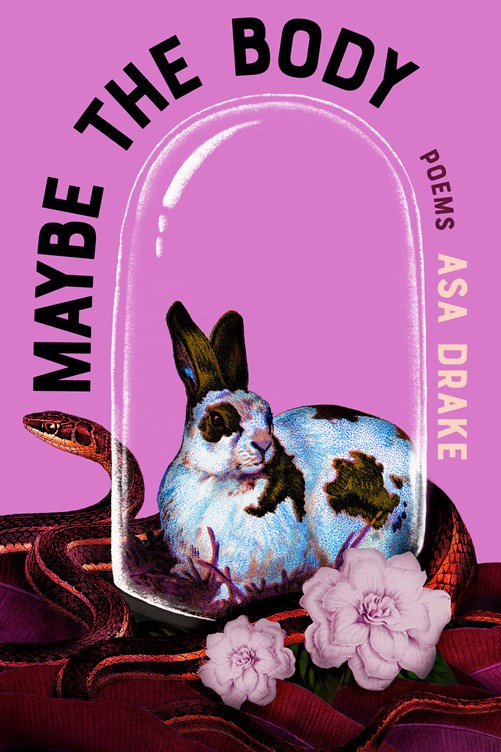
Asa Drake’s new poetry collection, Maybe the Body, is lush and fierce and teeming with love, though the speaker admits that “it’s the wrong year / to write a love poem.” This is a line that I’ve been thinking about a lot in the weeks since I first read the collection — it feels very true to me, but it also feels like maybe there’s no better time to write a love poem, to declare love for your people, for the plants and animals in your ecosystem, for the many places you call home. These poems explore what it means to carve out a place for yourself in the world and what it takes to protect the places and people you’ve chosen — and perhaps even how to choose yourself.
Asa Drake is a Filipina/white poet in Central Florida. A 2024 National Poetry Series finalist, she is the recipient of fellowships and awards from the 92Y Discovery Poetry Contest, the Florida Book Awards, the Rona Jaffe Foundation, Storyknife, Sundress Publications, Tin House, and Idyllwild Arts. Her poems have been published with The Slowdown Podcast, The American Poetry Review, The Paris Review Daily, and The Georgia Review. A former librarian, she currently works as a teaching artist.
This collection has a deep connection with the natural world and talks a lot about the relationships between humans and animals and plants. Have you always been a naturalist in this way, like a very outdoorsy kid, or have you more recently come to appreciate the natural world? What makes you feel most connected to the land?
Kingstree, my hometown in South Carolina, has maybe 3,000 people, and I grew up just outside of town. I remember a lot of pomegranates and pears and muscadines, and I also remember my first grocery store fruit bought as a novelty — a granny smith apple when I was maybe three or four. I don’t think my parents consider me outdoorsy, but I could entertain myself by paying attention.
Probably it’s worth noting that this home was a kind of heirsland tied to an old name and divided constantly among family, never sold. Equally worth noting is that the house I grew up in was crushed when we left by wisteria (sinensis) my mother planted. The last time I visited on my own, a cousin met me on the dirt road with a shotgun. Though I’m the only one of my father’s children who grew up on this land, I likely won’t inherit. My connection to the land is, as a result, immediately personal and political.
I’m a little shy to identify as a naturalist because I’m so often seeking myself in the landscapes I inhabit. I often think about how writers have engaged with the pastoral because pastoral isn’t merely a description of landscape but a political term, especially in the United States. I’m thinking specifically of Leo Marx’s The Machine in the Garden and Alexis de Tocqueville’s vision of America. There’s a myth of America starting from the premise of the garden, and it’s flawed. (Or maybe the garden is a very apt term, naively interpreted. After all, a garden always implies, but sometimes disguises, a human hand.)
Arcadia as a pastoral paradise is a fiction, one that certain narratives about the United States have used to overwrite the existing history of North American people. And again, with industrialization, to reject a society that extends toward immigrant communities. It’s this history of the pastoral — its associations with agrarian living and colonial expansion — that shapes my interest in how terms like invasive and native and non-native are used when describing plants and animals in the very real landscape of the Southeastern United States. The landscape within my book is often very literal, but the terminology I borrow to describe it reaches toward a political reality as much as a physical one. Somewhere in that terminology, I’m seeking language to describe the self.
How did you come to poetry? Do you recall the first poem that you read that made you think oh yeah, I could do this?
In a middle school Language Arts class, as a result of my teacher’s curation of a poetry segment where Li-Young Lee was the only living poet we read, I came to the conclusion that contemporary poetry was a very Asian American profession. We read “Persimmons” and “Braiding.”
The reason I stayed with poetry is because, in college, Prof. Joe Weil convinced me to drive with him to NYC (about a three-hour drive from Binghamton University) to a reading. He wanted me to see what an MFA might be like. I saw Jericho Jennifer Nelson read and we went to an afterparty where everyone recited favorite poems until we fell asleep on the floor. I was simply lucky enough to get a first glimpse of contemporary poetry that allowed me to feel like there was room for me. I imagine it’s so much easier to start from the premise of belonging than anywhere else.
An exploration of provenance and patriotism is clearly present in this collection – what does it mean to be from somewhere, what does it cost to love and leave a particular place, and what it costs to stay. I wonder if anything surprised you as you worked on these pieces? Did you set out to write on these themes or did they come together along the way?
All of the poems in Maybe the Body were written when I returned to the South after grad school. I might even go so far as to say that most were written after I’d started to feel at home again. I don’t think this was the result of sentimentality, but simply that I had a reference point from which I could measure my observations. I frequently compare the version of the South I knew growing up in South Carolina to the version I experience in Central Florida. In an interesting coincidence, the county I currently live in is named after a historical figure from my hometown, a distant cousin! My parents frequently try to prepare me with this sort of trivia, as if some greater claim to place might prevent me from being displaced.
For me, the questions of “what does it cost to love and leave a place, and what does it cost to stay” are the questions I’m constantly asked. Though maybe the phrasing might sound more like “why are you here,” and sometimes, “how are you here.” Like many Asian Americans, I’m used to the follow up, “where are you really from.” When I’m writing, I want to take control of the casual interrogations that shape my life because, no matter how prepared I am for the questions, I feel the shock factor.
The way other families might teach about stranger-danger, my family warned me about nationalism and colonial occupation in the practical way that they understood it. Their anecdotes made clear that many people will express familiarity with how I appear — as Filipino, as biracial — and that I should never assume that that familiarity means safety or acceptance. Often, someone else’s insistence on identifying the casual forces of my body is a dangerous sign — one that I try to confront more safely on the page.
One of the lines that has really struck me from this collection is “It’s so hard to write about love without writing about the country we live in.” What is your experience of writing and promoting a book in this particular moment in the U.S.?
I think the most important thing is to name this particular moment, and I don’t know if I’m fully equipped to answer. We’re seeing how terms of land and blood and belonging are weaponized against immigrants. But this particular moment is an ongoing one. Are we going to address how we exist in a police state designed to maintain property rights and not human rights — certainly not Black and Indigenous and immigrant rights (see: slave patrols as an early form of American policing)? I don’t have the best language to discuss America as the instigator of war (see: the American Wars) and not the rebel hero. I suspect this is a valuable question to ask writers who don’t explicitly engage with politics, too.
I’ve been thinking lately about Claude Monet’s Water Lillies, painted during World War I and the fact that I can describe them in greater detail than I can World War I. Can something beautiful retain the grain of something unbeautiful, or does the sentiment of one dominate the other? Do I want my poem to echo the current moment or offer something more direct — a dialogue, a record? I don’t think the echo is more or less artful than the artifact. Frequently, I think the distinction is a matter of audience.
I think the hardest aspect of marketing the book for me has been that I have always treated the audience as a theoretical possibility. I’ve considered different practices to offer (and deny) access to a general and imagined audience. But as we were finalizing materials for Maybe the Body in the early months of the second Trump administration, I felt real concern about what identifying information might be present in my work. The last things I added to Maybe the Body were acknowledgments. I actually had two versions drafted. One was extremely detailed because I have so many people to thank. And the other, the one I put into the collection, was a compromise between safety and fairness. I end up addressing the audience, not my loved ones.
I feel guilty that I did not thank everyone — institutions and mentors, especially, who enabled my work. But I was overwhelmed with how difficult it was to address family in a way that felt both sufficient and safe. If I couldn’t do one, I didn’t want to do the other. The reality of the audience, in that moment — which one might argue happens outside of the book — became overwhelming. But that tension very much defined how I wrote these poems.
Several poems in the book speak directly about the complicated legislative landscape in Florida, though they’re also rooted in what’s beautiful and wild in the area – cottonmouths, osmanthus flowers, ripe peaches. This region is dangerous for many people and that’s something we’re all reckoning with, but it’s important to talk about what makes living here worthwhile, what makes so many of us fight to save it. So, what do you love most about your corner of the South?
I really treasure the places that make me feel safe. Maybe the Body opens with a poem set in a family-owned restaurant, Great Wall, where the owners always tell me that they see me. There are several persimmon poems inspired by the Persimmon Farm in Jonesville, Fla., which happens to share space with Lulu’s Gelato. I start checking for ripe persimmons the second week of September, but if I miss them, I sometimes get a second chance at Ward’s Supermarket. These are all businesses, but they’re also places that build community.
In terms of place, so many of my poems are written or drafted at parks and cemeteries (they’re so much like parks!) in Ocala, Fla. or the SEEP (The Stormwater Ecological Enhancement Project) in Gainesville, Fla. Lately I go to the SEEP to see clouds of velvety atala around the boardwalk. Butterflies back from the brink of extinction! Their larvae rely on the coontie plants that the nearby museums have started using in their landscaping. I don’t want to use the natural world as a metaphor, but I hold on to the reminder that what’s at stake isn’t wholesale. The future isn’t double or nothing, it’s the result of consistent organization and action. We have to do the work for what we love.
Beauty Talkis also set to publish this year with Noemi Press. Is there anything you’d like to tell us about that project?
Toward the end of writing Maybe the Body, I started writing a parallel project, Beauty Talk, where I insist on a more granular reading of my identity as white and Filipina — and the contexts in which whiteness does and doesn’t function for me, in terms of culture and belonging. There are poems that formed between the two collections like “Afternoon in the Cemetery” and “What Migration Will Do to You” which I really treasure. At the beginning of writing Maybe the Body, I couldn’t have written these. I felt a professional obligation as a librarian to make myself approachable. And these poems, I think they make me less approachable. Even if a library patron never reads them, I, having written them, feel less obligation to make myself welcoming to others. What a guilty thought!
I love the concept of a (FR)I(E)NDEX! How do you keep up with lines or memories or conversations that are particularly significant to you?
I can’t believe the (FR)I(E)NDEX made it to publication! Frank O’Hara once said, “if I wanted to I could use the telephone instead of writing the poem.” So many of these poems were made through conversations, and I wanted a way to cite the people on the other end of the line. I wanted to be transparent about both borrowed language and gifted inspiration. And because of my journals, the (FR)I(E)NDEX was easy to make. We often talk about the poetry of witness, and I suppose my poems are something adjacent to this? As someone who has frequently been told that what I say isn’t credible, the poem becomes my witness.
I think many of us grew up with the idea of poems being tools to preserve memory or sentiment. (My friend Namita writes poems for everyone’s birthdays!) I have never been very good at writing poems for special occasions, but frequently, my poems grow from journal entries, notes from phone calls, and group chats. I really cherish the ways we can build our own archives (personal and otherwise), and how these self-made documents can validate our experiences in a way institutional archives may not. Of course this concept is also borrowed from a friend. A few years ago, E. Hughes introduced me to Saidiya Hartman’s concept of critical fabulation which has been essential to so much of my practice as a writer.
Thank you so much for chatting with me, Asa — I’ll definitely be thinking about this collection for a long time.
POETRY Maybe the Body
By Asa Drake
Tin House
Published February 24, 2026







0 Commentaires