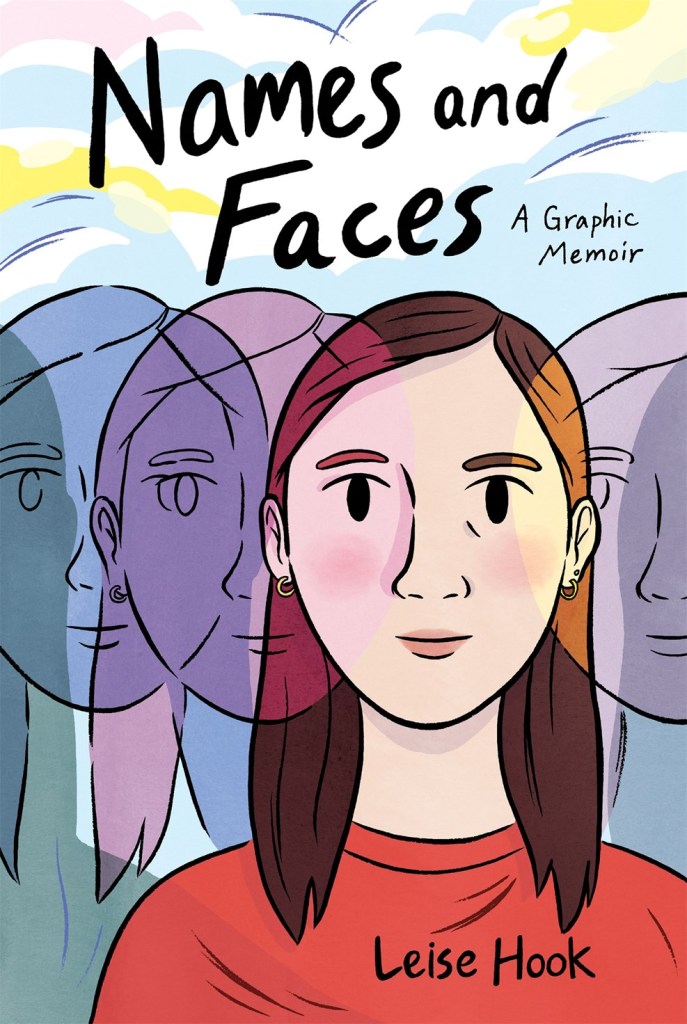
“Names and Faces”: A Lyrical, Inventive Exploration of the Self https://ift.tt/sVun0CQ
Who are we if not our names and faces? Where do we come from? What does it mean to exist between two identities? Two worlds? Two cultures? These are the questions Leise Hook seeks to ask in her stunning new graphic memoir in essays,Names and Faces, a lyrical, inventive exploration of the self that also looks out into the world through comics that experiment with form and content. In a fast-paced society that demands our attention on screens, or our impulse buys and constant clicks, this writer and artist invites you to slow down and take a deep breath.
Hook’s poetic, introspective writing style and innovative cartooning will appeal to readers of lyrical nonfiction works like How Far The Light Reaches: a Life in Ten Sea Creatures by Sabrina Imbler, for her interweaving of identity, belonging, and the natural world, and alternative, autobiographical comics full of depth and feeling such as Portrait of a Body by Julie Delport, for her innovative layouts and equally beautiful prose. The art asks what a comic can do in pages full of visual metaphors that break out of the strict confines of the form, much like Hook breaks out of the mold society tries to box her into.
Hook tells us in the introduction that Names and Faces is her attempt to answer “all the questions I’d been collecting and ignoring. . . about myself, my family, and what it means to have a mixed identity in a world that insists on its impossibility.” She uses the comics medium to explore heritage and coming of age, describing the process as “a fresh lesson in the difficulty and reward in peeling back the layers of a story.”
In the first segment, titled “Names,” Hook writes: “A name is a history of where and who you come from. But a name can be a prophecy. We’re eager to know if our names make us who we are.” The drawings exist in a liminal third space between truth and imagination, using the visual metaphor to add power to the words. We see a child surrounded by their older silhouette, two doctors discussing how a name can be a predictor of success. I enjoyed her inclusion of Hannah Emery’s study on naming practices as a way to explore the cultural significance of names in the lives of multiracial children.
Through eloquent pages that play with white space, associative sequences, and a pastel color palette, the cartoonist explores the origins of all her names and their role in her life, including how people often don’t expect her to have her name, or a Chinese name. As a result, she feels like she has to pick one identity, then realizes she can hold space for both. Like Leise’s name, her comics exist “on an unfixed border” and aren’t afraid to shift shape.
My favorite essay from the book was “Just Like Me,” about Hook’s childhood searching for herself in American Girl Dolls in the mid-1990s, at the height of the brand’s popularity. She weaves together research on the brand, the impact of dolls on childhood development, and her own specific yet universally relatable desire to get a doll who shared her appearance, only to be met with the lack of representation available for biracial girls like her. White girls are given numerous stories on the shelves, multiple options, while everyone else is handed a “blank book,” and the only choice is to make their own doll, their own appearance, their own story. The speaker reflects on the need for everyone to see themselves in the media they consume and the toys they play with as children by showing us the “Choose your Own” doll section of the American Girl Doll store, writing, “I needed to know we all deserve more than blank books.”
Another section I loved is titled “The Vine and The Fish.” In it, Hook interweaves research about the natural world with her own experiences, much as she does throughout the collection, in order to explore her experience of feeling uprooted. Hook connects the language used to describe invasive plants like kudzu to the language used to describe immigrants in America, writing, “When we talk about invasive species, we tend to use violent metaphors and assign intention to plants and animals.”
Hook then shows us a splash page featuring different species named for the places in which they’re found, including the “Chinese Wisteria,” “Japanese Knotweed,” “Russian Thistle,” and “Indian Marshweed.” These naming conventions tend to carry a negative stigma. What do the names we give to the natural world reveal about our biases? About our perception of anything we deem other? About who belongs here, and who doesn’t? These questions are threads in the book. She finds herself, too, in the Asian carp, as well as a beetle. The poet Mary Oliver once wrote that our “endless and proper work” is to “pay attention.” Leise Hook is an artist who pays attention, and in turn, asks us to do the same.
GRAPHIC NOVEL Names and Faces By Leise Hook Holt Published April, 14, 2026







0 Commentaires