“Love Tap”: A Tender, Visceral Debut https://ift.tt/L1INlnk
The opening poem of Bernardo Wade’s 2025 collection, A Love Tap, asks, “You ever negotiate with an apparition?” This negotiation is exactly the endeavor this vulnerable debut undertakes. Set amidst the thrum and ache of a vibrant New Orleans, its poems reanimate the speaker’s tangled past to examine themes of Black masculinity, community, addiction, and family ties. Guided by Wade’s striking verse and skillful use of poetic form, these poems pull no punches and yet are stunningly tender when at their most visceral.
Wade’s narrating voice is arresting, slipping between a swaggering humor and the kind of honesty that can only be delivered in a whisper. His narratives overflow with living ghosts — family members, strangers, ancestors — that buck and defy Wade’s search for mercy. In one poem modeled after Lucille Clifton’s fox poems, his grandmother appears “to clown this elegy/to say/chile I’ve done/my work/now let me walk away.” In another poem, buoyant with rhythm and blues, his mother emerges from his imagination to tell him, “I’m not here to be/your little muse.” The past offers no easy answers to the narrator’s grappling, instead becoming a mirror that reflects back his own hurt and desperation. And yet, Wade tells readers that this unearthing is necessary because the past is living: “We don’t bury our dead/…’cause our blood is still at play.” In “The Hymn,” one of the most dreamlike yet intense poems of the collection, Wade describes the ghost of “the boy/you’ve already grieved” climbing through the window at night and coaxing the narrator into a relapse. Tenderness permeates even this moment when “the boy stops/the constellation bleeding from the pale crook/of your arm with a kiss.” In this instance, the past’s living quality is a dangerous and human thing, always poised to bleed its way back into the present as Wade tries to untangle the kinship between the two.
At the core of A Love Tap is his complex relationship with his father, whose presence is at once both painful and familiar to the narrator. In one poem, he likens Hurricane Ida to the wake of destruction that only a parent can leave, saying, “the next day/the sun comes out like a parent,/like nothing ever happened.” Deftly avoiding one dimensionality, Wade’s visceral writing never slips into exploitation but rather holds each moment up to the light to find its humanity. He describes an embrace between the two of them after pawning his father’s gold ring to get his fix: “we were no longer/a tangle/of two fiendish men/but became/ugly & tearful/seeing in the other/an animal/neither could hold.” In another poem, he avoids his father’s phone calls, instead opting to connect with him through imagining his father “pubescent & peach-fuzzed,/bending down to drink/from the BLACKS ONLY fountain.” Wade’s writing tries hard to understand and humanize the men that came before him; in the collection’s stunning final poem, he longs to “retune the heart-/strings of hard men to offer/them this new language” of tongues rather than fists. Through searching for this understanding, Wade’s poetry probes what it means to be a son, carrying with him the heavy burden of ingrained masculinity and the racialized history of New Orleans.
That history and culture is omnipresent throughout the collection, conjuring the city as not just an organic backdrop but a ghost in its own right. The nature of this ghost is as comforting as it is cruel to the narrator. In “God Made Dirt, & Dirt Ain’t Popeyes,” a meticulously constructed broken sestina, he describes the hunger of New Orleans as a city where “someone/simmers the cayenne-soaked grease bucket like/God lit the fire because He felt a mother’s pressure, like/he wanted a day off from feeding these children.” Some of the most haunting moments in these poems are tied closely to their landscape, a place where blue lights and sirens are always “knifing through the night” after “hot-blooded men.” One poem describes an inhumane scene in the Orleans Parish Prison where the narrator’s only mercy is granting another man the decency “to be left alone” in a place where a mother’s tenderness can’t reach. In “This Shit Is Not Interesting,” our narrator longs for this tenderness on the floor of a jailhouse, where he can “almost taste/my mother’s gumbo on Christmas Day,” and is given only the small kindness of a stranger covering his body with a coat.
Alongside scenes of incarceration and small mercies, Wade weaves in our country’s racial history. One poem sees the spirit of Rayshard Brooks inhabiting the narrator’s backseat, telling him to keep driving. Another dissects the complicated past of Mardi Gras, where being a flambeaux man is both a source of shame and pride, and rich white folk with “pearly-toothed mansions” turn into monsters after dark and “(slither) into a vile/corner of the swamp,/lusting after flesh.” Among the collection, there are ekphrastic poems that breathe life into Dawoud Bey’s photography in Harlem, imagining the images as a way for Black Americans to carve a space of their own. Wade finds this space in nature too, watching crows roost together “like strange fruit nestling/for warmth — the survival of kin.”
These moments of beauty are far from scarce in this collection — which doesn’t shy away from brutality either — and give the reader glimpses into a hopeful future. A Love Tap is an essential read for this time in our country’s history, where the ugliness of our past and the bleakness of our present collide daily. Wade’s poetry offers readers another perspective, one in which violence and apathy can be counteracted through community and human understanding in a country where mercy is so sorely needed and yet so rarely given.
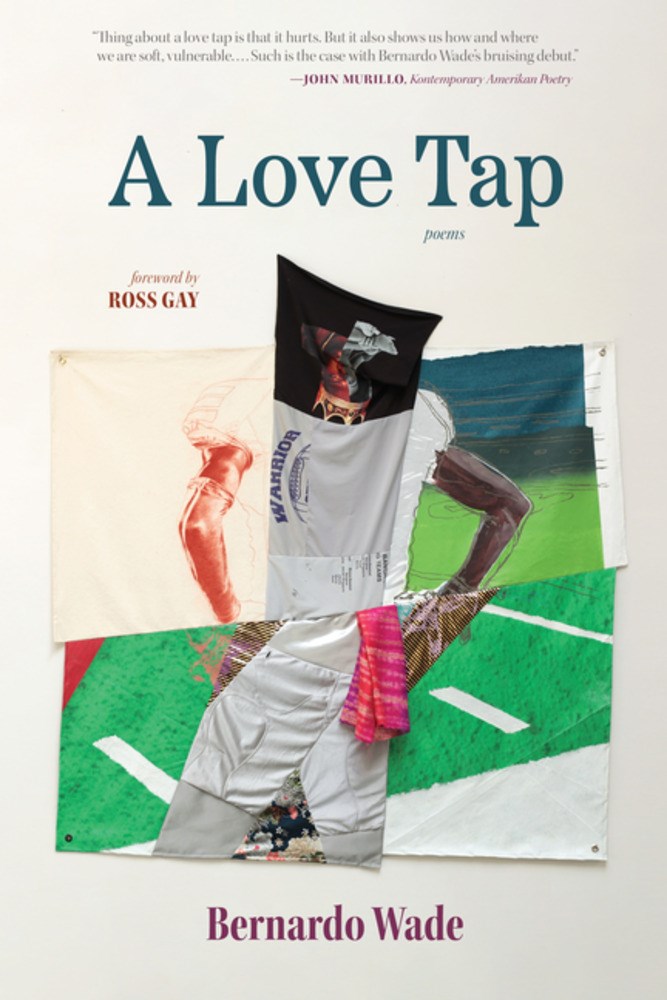
A Love Tap
By Bernardo Wade
Lookout Books
Published October 21, 2025




0 Commentaires